

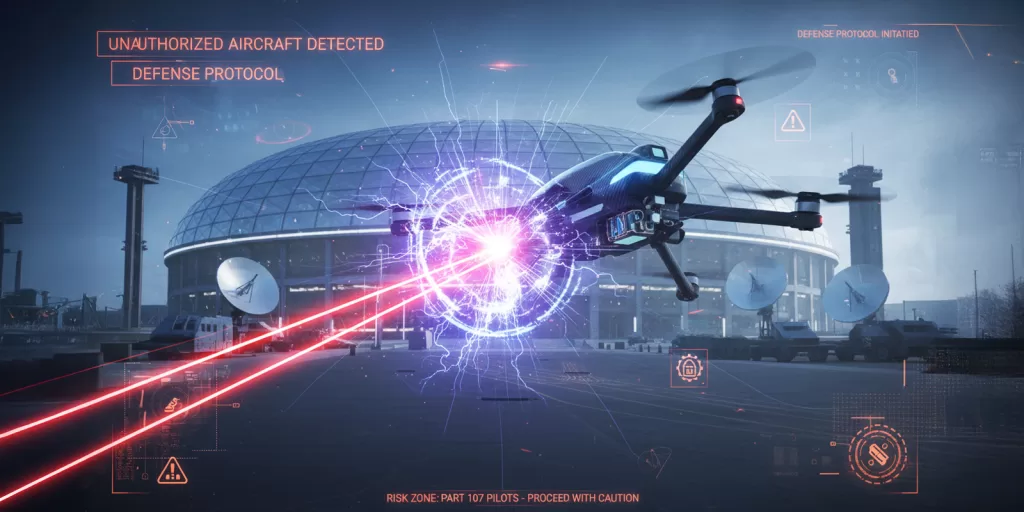
As a Part 107 pilot, you’ve navigated the complex world of FAA regulations, but a new federal law is about to introduce a whole new level of risk. The NDAA has authorized cutting-edge ‘drone defeat’ systems that could destroy your aircraft in an instant. From military bases to stadiums, these systems are already being deployed, and they could be targeting your drone. Keep reading to find out what this means for your operations—and how you can protect your business before it’s too late.
Introduction: A New Era of Risk for Commercial Drone Operations
As a certified Part 107 commercial drone pilot, you are accustomed to navigating complex FAA regulations where the primary risks of non-compliance are fines and certificate actions. However, a foundational shift in federal law is laying the groundwork for new and significant physical risks to your aircraft. The latest National Defense Authorization Act (NDAA) authorizes a formal, government-wide architecture for deploying sophisticated counter-drone technologies. These systems are designed not just to deter, but to actively defeat unauthorized aircraft.
The purpose of this article is to explain what these new “drone defeat” systems are, the framework being established for their deployment, where they are most likely to be encountered first, and what you must do to protect your aircraft and your business.
1. What the New NDAA Means for the National Airspace
The National Defense Authorization Act (NDAA) is an annual piece of legislation that authorizes funding and sets policy for the Department of Defense. The latest version includes a section titled TITLE LXXXVI—SECURING THE AIRSPACE, FACILITATING EMERGENCY RESPONSE, AND SAFEGUARDING KEY INFRASTRUCTURE, ENTERTAINMENT VENUES, AND STADIUMS. This language signals a major federal initiative to control airspace against unauthorized drone activity, an initiative that will directly impact all operators in the National Airspace System, including licensed professionals.
2. Understanding “Drone Defeat”: Beyond Jamming
The new NDAA establishes the legal and organizational framework for the procurement and deployment of a new generation of Counter-Unmanned Aircraft Systems (C-UAS). Section 912 of the act creates a new task force and assigns it the responsibility of coordinating efforts across the Department of Defense to procure counter-sUAS kinetic and non-kinetic defeat capabilities.
For the professional pilot, it is critical to understand what “defeat” means in this context.
- Non-Kinetic: These are actions that do not involve a physical projectile. They include jamming a drone’s control or GPS signal, spoofing its navigation, or actively taking control of its command link.
- Kinetic: These are actions designed to physically disable or destroy the drone. Technologies specifically mentioned in the legislation, such as high-powered microwaves and lasers, fall into this category.
It is important to note that the specific mention of systems capable of destroying or disabling a small unmanned aircraft by means of high-powered microwave, laser, or other similar technology comes from Section 1089, which authorizes a pilot program. While not yet a widespread capability, this law authorizes the testing of these systems in the field. The financial and operational risk is now clear: a non-compliant flight near a protected area could result in the immediate and total loss of your aircraft.
3. The Joint Task Force Leading the Charge
This new counter-drone initiative is not a fragmented effort. Section 912 of the NDAA establishes the Joint Interagency Task Force 401 as a permanent entity. Its primary responsibility is to serve as the main body within the Department of Defense for the validation and approval of counter-sUAS systems for procurement and use by the Department. The establishment of this task force formalizes a coordinated, government-wide push to deploy these technologies.
This Task Force will be the central body validating the very technologies, such as those being tested in the pilot programs at military installations, for wider procurement and deployment, significantly increasing the long-term likelihood of encountering them in the field.
4. High-Risk Zones: Where Will These C-UAS Systems Be?
Based on the language in the NDAA, pilots must now assume a higher level of risk when operating near specific types of locations. These areas are the initial focus for the pilot programs authorizing the deployment of advanced C-UAS systems:
- Military Installations: The legislation explicitly authorizes pilot programs focused on base defense (Sections 1088 and 1089), making any flight near a military facility extremely high-risk.
- Critical Infrastructure: The title of the legislation (Title LXXXVI) and a specific pilot program (Section 1089) identify the protection of critical infrastructure as a key objective. Pilots must be aware of power plants, dams, federal buildings, and other sensitive sites.
- Entertainment Venues & Stadiums: The title of Title LXXXVI also clearly names “Entertainment Venues, And Stadiums” as areas to be safeguarded, meaning Temporary Flight Restrictions (TFRs) over these events now carry a much more severe penalty for violation.
5. Risk Mitigation: Essential Steps to Protect Your Drone Assets
The introduction of “drone defeat” systems requires Part 107 pilots to adopt a more stringent risk mitigation strategy. Standard pre-flight checks are no longer sufficient to protect your assets.
- Practice Extreme Airspace Diligence: You must meticulously check for all advisories, including last-minute TFRs, before every flight. This is especially critical when operating anywhere near the high-risk zones identified in Section 4. Double-check all data sources.
- Verify Your Flight Location: Before accepting a job at a new location, conduct thorough research to identify any proximity to military installations or critical infrastructure that may not be immediately obvious on standard aviation maps.
- Assume All Sensitive Locations are Protected: The safest operating assumption is that any location mentioned in Section 4 is protected by C-UAS technology, whether its presence is publicly announced or not. Do not assume you will receive a warning.
- Re-evaluate “Gray Area” Operations: Strongly avoid flying in ambiguous or poorly-defined airspace boundaries. The consequence for a mistake is no longer a potential warning letter from the FAA, but the potential destruction of your equipment by a system you may not even see.
Takeaway: Professionalism and Diligence Are Your Best Defense
The new NDAA marks a significant shift in airspace management. It establishes the formal government architecture for deploying sophisticated counter-drone systems that pose a direct physical threat to UAS assets. While initial deployment is concentrated in pilot programs, this legislation signals the start of a coordinated, long-term federal policy. The line between a compliant and a non-compliant flight has become much sharper, and the penalties for crossing it are far more severe.
In this evolving regulatory and technological landscape, your best defense is unwavering professionalism, meticulous flight planning, and continuous education. Safeguarding your operations now means protecting your aircraft from more than just operational hazards—it means protecting them from active defeat.
If you have any questions, let us know! If you’d like to hire us, you can get more information here.
Written by: Tony Marino, MBA – FAA Certified Part 107 Commercial Drone Pilot and Chief Business Strategist at Aerial Northwest
Disclaimer: The information provided in this blog post is for general informational purposes only and should not be construed as legal advice.
Resources
FAA Resources: FAA DroneZone
Article: What Does it Mean to Decode the Drone Industry?
Article: Pitch Perfect: Guide for Drone Pilots to Get Jobs
References
Kesteloo, H. (2025, December 15). NDAA 2026: Local Police to Gain New Powers to Take Down Your Drone. DroneXL.co
U.S. House of Representatives. (2025, December 7). Rules Committee Print 119–16: Text of House Amendment to S. 1071 (National Defense Authorization Act for Fiscal Year 2026) (H.R. 3838, 119th Cong.).
Starting Your Own Drone Service Business
Pick up your copy today on Amazon and wherever fine books are sold.

DRONE BUSINESS STRATEGY MAGAZINE
A free digital publication made exclusively for all small business drone pilots to them help start-up, become profitable while sustaining a competitive advantage within the drone service industry sector they opt to serve.
“If you love to fly, we’d love to have you come aboard!”
We share your information with no one. Our Privacy Policy.







1 Comment
Leave your reply.