

The drone industry did not collapse. It matured—and mature markets are unforgiving. What once differentiated you now merely qualifies you. Stunning footage, advanced aircraft, and flawless execution are no longer competitive advantages; they are baseline expectations. Across construction sites, agricultural operations, and real estate firms, budgets are tightening, compliance is intensifying, and clients are prioritizing measurable outcomes over visual spectacle. Operators who fail to recognize this shift experience it as pressure—on pricing, on margins, on positioning, and ultimately on identity.
The Drone Zeitgeist is the strategic framework for decoding these invisible forces. It challenges professionals to move beyond technical mastery and into structural interpretation—to understand how regulation, technology, capital flow, and client anxiety shape demand. In a recalibrating industry, survival does not belong to the most skilled pilot, but to the most aligned strategist. The question is no longer whether you can fly. It is whether you can read the era.
1. Introduction: Defining the Invisible Operating System
In the current drone economy, technical proficiency has reached a state of saturation. To navigate this landscape, the professional operator must decode the “Drone Zeitgeist”—the spirit of the time that functions as the invisible operating system for the entire market. This force dictates regulatory trajectories, technological evolution, and the fundamental mechanics of client decision-making. Strategic maturity requires an immediate transition from emotional, reactive management to a structural interpretation of these forces.
While technical excellence is mandatory, skill alone no longer provides a competitive advantage. The market is currently recalibrating, shifting its rewards away from individual maneuvers toward strategic alignment. When an entrepreneur fails to read the structural forces pressing upon their firm, they experience those forces as external friction rather than opportunity.
The High Cost of Strategic Misalignment
The “Qualification Trap” is a systemic failure of leadership to distinguish between operational capacity and market differentiation. Misalignment manifests as:
- Systemic Price Pressure: A “race-to-the-bottom” dynamic where services are perceived and purchased as commodities.
- Margin Erosion: Increasing operational overhead that cannot be recovered because the client perceives no incremental value.
- Identity Dilution: A “jack-of-all-trades” approach that destroys brand authority and specialist premiums.
- Strategic Obsolescence: Maintaining state-of-the-art hardware and certifications while remaining fundamentally out of touch with what the market is willing to fund.
To solve these pressures, we must first diagnose the industry’s shift from a developmental novelty to a mature utility.
2: Phase I: The Maturity Shift — From Novelty to Utility
The drone industry has moved decisively from an era defined by spectacle to one governed by utility. In its infancy, the simple act of flight was a differentiator; the ability to capture aerial imagery alone created value. Today, that advantage has evaporated. High-quality footage, precise mapping, and polished deliverables are no longer unique selling propositions—they are entry requirements. What once impressed now merely qualifies. Strategic survival begins with recognizing that excellence in execution is assumed, not rewarded.
This shift reflects a broader transformation in market expectations. Yesterday’s market was novelty-driven: spectacular visuals, artistic impact, and experimentation captured attention. Today’s market is utility-driven: clients prioritize actionable data, operational integration, measurable ROI, and compliance. The success metric has evolved from the “wow” factor to efficiency and workflow alignment. As the industry professionalizes, independence gives way to standardization, and artistry yields to process integration.
Many drone entrepreneurs fall into what can be called the Qualification Trap—the belief that sharper imagery or more complex maps will unlock higher-tier contracts. In a mature market, strong deliverables make a firm qualified; they do not make it differentiated. True differentiation is no longer found in the “what” of the footage, but in the “how” of the business outcome it enables. Sector-level alignment—translating technical capability into economic value within a specific vertical—is the only viable path forward as the industry continues its progression toward maturity.
3. Phase II: The Double Zeitgeist Framework
Strategic advantage is found at the intersection of two distinct forces: the evolution of the drone industry and the specific pressures of your target vertical. This is the “Double Zeitgeist.” While your technical flight skills remain constant, your positioning must remain fluid, translated specifically into the economic language of the sector you serve.
Market-Specific Value Translation
Aligning with the “Market Spirit” requires diagnosing the core anxieties of your clients:
- Construction:
- Market Spirit: Focused on risk mitigation, documentation, and liability.
- Required Positioning Shift: Move from “aerial views” to a “risk-reduction partnership” integrated directly into existing reporting workflows.
- Agriculture:
- Market Spirit: Driven by yield optimization and cost efficiency.
- Required Positioning Shift: Move from “multispectral imaging” to “precision optimization” that impacts the bottom-line cost per acre.
- Real Estate:
- Market Spirit: Defined by margin compression and marketing velocity.
- Required Positioning Shift: Move from “stunning photography” to “accelerated listing velocity” and ROI protection.
Outcome-Oriented Pitching: Solving “Client Anxiety”
Consider the pursuit of a $30,000 construction progress contract. A technical pitch focusing on cinematic quality fails because it misreads the room. The client’s primary driver is not aesthetics, but Client Anxiety regarding liability and documentation. A winning pitch frames the drone not as a camera, but as a data-driven documentation system that reduces legal friction. Execution is the baseline; interpretation of the client’s internal pressure is the differentiator. Having established the sector-specific value proposition, the strategist must then decode the technical signals that either threaten or bolster that position.
4. Phase III: Interpreting Technology and Regulation as Strategic Signals
Technology and regulation are not random disruptions; they are reflections of the market’s structural direction. A strategic operator does not merely react to these shifts; they interpret them to inform capital allocation.
Decoding Structural Signals
- Remote ID → Traceability: Signals a shift toward accountability. Strategic Outcome: Reduced legal friction and increased institutional trust.
- Automation → Scalability: Signals a move away from manual pilot reliance. Strategic Outcome: Increased operational leverage and repeatable margins.
- Artificial Intelligence → Efficiency: Signals that data processing is now more valuable than data collection. Strategic Outcome: A migration of value from the field to the cloud.
- Regulation → Institutional Integration: Signals that drones are becoming a permanent, transparent fixture of the economic infrastructure. Strategic Outcome: Long-term market stability.
Risk and Capital Allocation
A strategic interpretation of the Zeitgeist informs financial discipline. Geopolitical risks and supply chain instabilities are signals for fleet diversification. Rather than reacting with panic, the strategist uses these signals to inform capital decisions—investing in platforms that align with the market’s move toward transparency and domestic security.
5. Phase IV: The Forecasting Edge—Noise vs. Structure
The primary failure in drone entrepreneurship is confusing “noise” with “structure.” Strategic forecasting requires a rigorous filtering process that prioritizes economic reality over emotional headlines.
The Decision-Making Audit
To protect capital, time, and energy, every market shift must be put through a rigorous audit:
- Is this structural or temporary? Is this a permanent regulatory shift or a transient news cycle?
- Is this fear-driven or economically driven? Are budgets actually shifting, or is this social media outrage?
- Is this narrative or validated demand? Is there a documented willingness to pay for this new feature, or is it merely hype?
- Is this local or industry-wide?
The Impact of Interpretation
Asking these questions creates leverage. Technical excellence earns entry into the market, but interpretation earns leverage within it. By filtering out the noise, the operator identifies the true direction of the industry before emotion dictates their capital decisions.
6. Summary: Operating Within the Economic System
The modern drone pilot must shed the identity of a “technician” and adopt the identity of a “strategist.” You are an operator within a living economic system. Success is no longer found in chasing the newest hardware, but in aligning your business with the structural forces of the era.
Strategic Mandates
To secure a competitive advantage, you must implement the following directives:
- Stop pricing defensively: Pivot the conversation away from the “cost of the mission” toward the “value of the business outcome.”
- Stop chasing trends impulsively: Filter every technological advancement through the “structural vs. temporary” audit before allocating capital.
- Align deliberately: Ensure your positioning and workflows are translated into the specific language and anxieties of your target vertical.
Final Statement
In a maturing industry, you face a binary choice: you can spend your career reacting to the era, or you can commit to reading it. Those who interpret the spirit of the time are the only ones equipped to lead it.
Takeaway: The Strategic Conclusion
In a mature drone industry, technical excellence earns you entry—but only strategic alignment with market forces earns you leverage. High-quality deliverables, advanced aircraft, and flawless execution are now baseline expectations, not differentiators. The operators who thrive are those who understand the structural pressures shaping regulation, capital flow, client anxiety, and technological evolution—and who deliberately position their services within that reality.
In this environment, success no longer belongs to the most skilled pilot, but to the strategist who reads the era correctly and aligns before the market forces alignment upon them.
If you have any questions, let us know! If you’d like to hire us, you can get more information here.
Written by: Tony Marino, MBA – FAA Certified Part 107 Commercial Drone Pilot and Chief Business Strategist at Aerial Northwest
Disclaimer: The information provided in this blog post is for general informational purposes only and should not be construed as legal advice.
Drone Pilot MBA Series
Drone Zeitgeist: The Drone Entrepreneur’s Advantage

Resources
FAA Resources: FAA DroneZone
Article: What Does it Mean to Decode the Drone Industry?
Article: Pitch Perfect: Guide for Drone Pilots to Get Jobs
Drone Business Strategy Magazine (Study Report):
PESTEL Analysis: A Critical Tool for Commercial Drone Pilots
Drone Business Strategy Magazine (Study Report):
Drone Pilot SWOT Analysis: The Key to Commercial Success
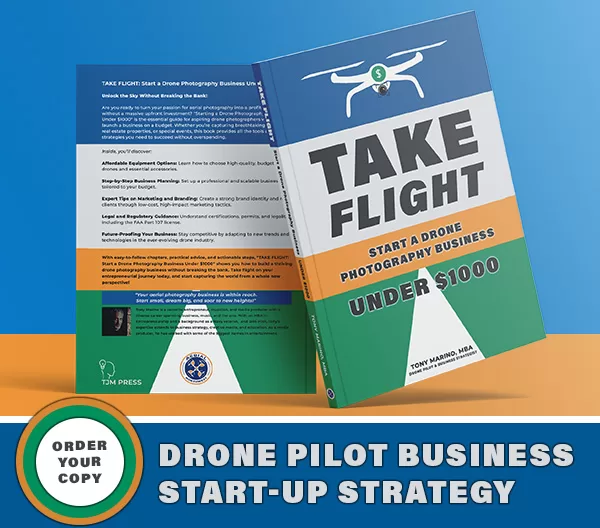
Starting Your Own Drone Service Business
Pick up your copy today on Amazon and wherever fine books are sold.

DRONE BUSINESS STRATEGY MAGAZINE
A free digital publication made exclusively for all small business drone pilots to them help start-up, become profitable while sustaining a competitive advantage within the drone service industry sector they opt to serve.
“If you love to fly, we’d love to have you come aboard!”
We share your information with no one. Our Privacy Policy.






1 Comment
Leave your reply.