

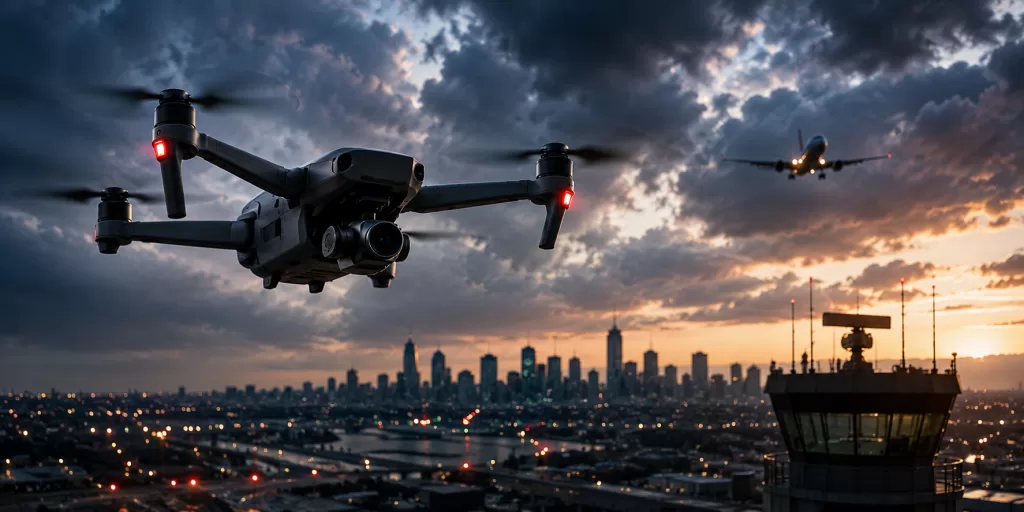
The rules of commercial drone operations are changing, and many pilots haven’t realized just how dramatically the FAA has shifted its enforcement strategy. Across the United States, the FAA is moving away from education-first compliance and toward aggressive enforcement of FAA drone regulations, Part 107 requirements, Remote ID, Temporary Flight Restrictions (TFRs), and controlled airspace violations. Whether you fly for business or recreation, a single mistake can trigger substantial FAA drone fines, certificate suspension, or a permanent federal enforcement record. As drones become more capable and accessible, the legal responsibility placed on every pilot has never been greater.
This article examines seven critical developments every commercial drone pilot and serious UAS operator needs to understand, from the FAA’s new DETER enforcement program and the myth of “sub-250g immunity” to expanding cooperation with local law enforcement through LEAP and the growing importance of preflight planning. If you want to protect your business, maintain your Part 107 certificate, and avoid costly enforcement actions that can exceed $20,000, these are the realities you need to know before your next flight.
1. The “Lamborghini” Dilemma: Why Capability Isn’t Legality
In the world of Unmanned Aircraft Systems (UAS), we are currently facing what I call the “Lamborghini Dilemma.” Just because you own a vehicle capable of 200 mph doesn’t give you the license to treat the interstate like the Autobahn. Similarly, today’s off-the-shelf drones can easily perform altitude excursions into the flight levels of manned aviation, but doing so is a fast track to federal litigation.
The era of the “friendly educational phone call” from the FAA has officially ended. The agency has pivoted from a “compliance first” mindset to a formal enforcement stance to protect the National Airspace System. The stakes were highlighted on June 29, 2026, when a JetBlue Airbus A321 on approach to JFK reported a drone collision at 3,000 feet—well into Class Bravo airspace. While the FAA investigation and post-flight inspection ultimately found no physical evidence of a strike or drone activity, the panic in the cockpit was real. For the FAA, the mere report of a drone at 3,000 feet, ten miles from a major hub, is enough to trigger a scorched-earth enforcement policy.
2. The DETER Program: Your One-Time (and Very Costly) “Get Out of Jail” Card
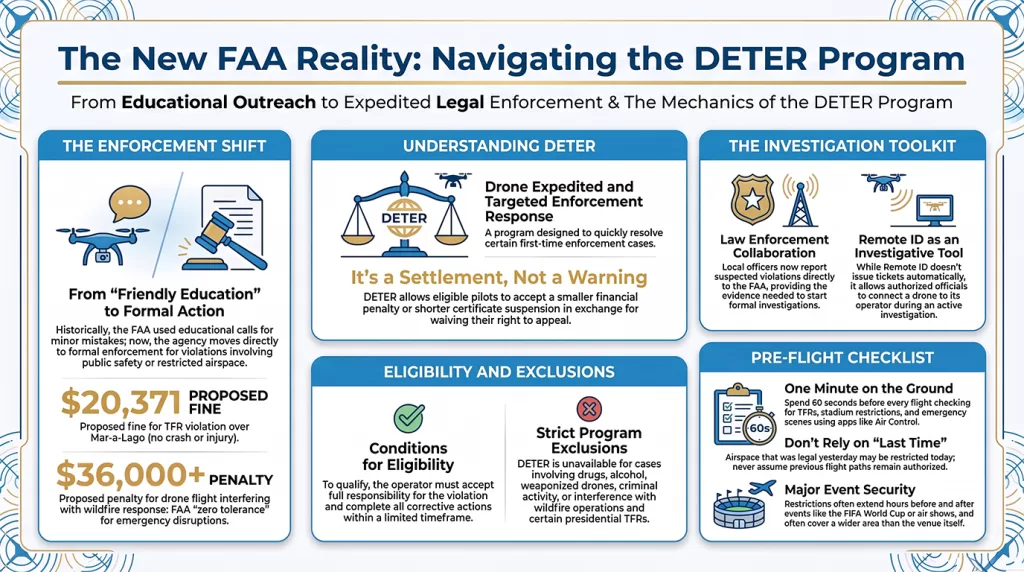
The FAA has launched the Drone Expedited and Targeted Enforcement Response (DETER) program. As a consultant, I tell my clients: this is a settlement offer, not amnesty. It is designed to clear the FAA’s docket of first-time offenders quickly.
- The “Discount“: Instead of the standard $15,000+ civil penalty per violation, DETER may allow a pilot to settle for a $250 fine or a 30-day certificate suspension.
- The Catch-22: To qualify, you must waive your right to an appeal and accept full responsibility. This creates a permanent federal enforcement record that can haunt your future insurance premiums and commercial contract eligibility.
- The “Red Lines”: DETER is not a universal shield. You are ineligible if the incident involved alcohol or drugs (the “eight hours bottle-to-throttle” rule), weaponized drones, criminal activity, or if the flight demonstrated a fundamental lack of pilot qualification.
“It’s essentially a settlement offer. The FAA is saying, ‘We’ll resolve this more quickly and possibly with a reduced penalty, but only if you accept responsibility now.'”
3. The “Sub-250g” Myth: Tiny Drones and the $20,000 Fine
There is a persistent, dangerous myth that if your drone weighs less than 249 grams, the rules don’t apply. This is a fallacy that can bankrupt you. While sub-250g drones might avoid registration for purely recreational flights, they are absolutely subject to Temporary Flight Restrictions (TFRs) and controlled airspace regulations.
In February 2026, the FAA proposed a staggering $20,371 fine against a pilot who flew over Mar-a-Lago during a presidential TFR. The drone’s weight didn’t matter; the violation of “protected airspace” did. Furthermore, if you use a “mini” drone for Part 107 commercial work with an external Remote ID (RID) module, you must register the specific serial number of that module to the aircraft. Mistakenly registering the drone without the module’s ID is a technical violation the FAA is no longer ignoring.
4. The “Swiss Cheese Model” and the Failure of Planning
In aviation safety, we use the “Swiss Cheese Model” to explain accidents. It’s rarely one mistake; it’s a series of “holes” in safety layers—pre-flight planning, airspace awareness, and weather monitoring—aligning perfectly to cause a disaster.
The reported JetBlue incident at JFK was a textbook alignment: the operator ignored Class Bravo restrictions, exceeded the 400-foot ceiling, and likely flew Beyond Visual Line of Sight (BVLOS). While that specific plane escaped damage, the physics are unforgiving. We saw the reality during the Palisades wildfire incident, where a 250g “mini” drone punched a clean hole through the leading edge of a firefighting aircraft’s wing, grounding a vital resource for an entire month.
“We collided with a drone back there in the turn. It hit us right right above the cockpit.” — JetBlue Pilot report to ATC.
5. Local Police: The FAA’s New Investigative Boots on the Ground
If you think the FAA is too understaffed to find you, meet the LEAP (Law Enforcement Assistance Program) initiative. Local police are now trained as the FAA’s eyes and ears.
Under LEAP, an officer on the scene isn’t just “asking you to land”—they are securing the “initial investigative data.” They collect the Remote ID broadcast info, pilot ID, and flight logs to build a case file that is handed directly to federal investigators. Remote ID isn’t a “ticketing tool” yet, but it is a powerful investigative tool used to link the drone to the person holding the controller. This system was proven during the 2026 FIFA World Cup, where authorities utilized these tools to identify and confiscate over 600 unauthorized drones. The gap between your flight and a legal summons has shrunk from months to days.
6. TFRs: The “Pop-Up” Danger You Aren’t Checking
Temporary Flight Restrictions are the leading cause of massive civil penalties. You must treat every flight as if the airspace has changed since yesterday.
- Standing Stadium NOTAM (0/0367): This is a “hidden” rule. Any stadium with 30,000+ seats has a standing TFR covering a 3-nautical-mile radius, effective from one hour before to one hour after the event. It won’t always pop up as a bright red circle on every app—you are expected to know the schedule.
- Wildfires: This is the FAA’s “zero tolerance” zone. Interfering with a wildfire TFR carries a proposed penalty of over $36,000 because it grounds life-saving aerial tankers.
- Aviation Pro-Tip: Beyond checking apps like Air Control, veteran pilots check the K-index. High geomagnetic activity from solar flares can degrade your GPS and Command & Control (C2) link, turning a legal flight into an “unintentional” fly-away violation.
“One extra minute on the ground can save you weeks or even months of dealing with an FAA enforcement case.”
Takeaway: The Horizon of Part 108
The FAA is currently using the “stick” of enforcement to prepare us for the “carrot” of Part 108. This upcoming final rule will eventually standardize BVLOS and heavy-lift operations, moving the industry toward a truly commercialized sky. However, the FAA will only grant those privileges to pilots who prove they can respect the current boundaries.
Preparation is no longer a best practice; it is your only legal shield. The technology makes it easy to fly, but the law requires you to be a pilot. Before you chase that “perfect shot” over a crowded stadium, ask yourself: Is that photo worth a permanent federal enforcement record and a $20,000 bill?
Slow down, check your NOTAMs, and fly like the professional the FAA expects you to be.
If you have any questions, let us know! If you’d like to hire us, you can get more information here.
Written by: Tony Marino, MBA – FAA Certified Part 107 Commercial Drone Pilot and Chief Business Strategist at Aerial Northwest
Disclaimer: The information provided in this blog post is for general informational purposes only and should not be construed as legal advice.
Drone Pilot MBA Series
Your Next Drone Flight Might Be Your Last: New FAA’s “DETER” Rules

Resources
FAA Resources: FAA DroneZone
FAA Resources: FAA DETER Program
Article: What Does it Mean to Decode the Drone Industry?
Article: Pitch Perfect: Guide for Drone Pilots to Get Jobs
Video: 51 Drones: The FAA is Cracking Down on Drone Pilots!
Drone Business Strategy Magazine (Study Report):
PESTEL Analysis: A Critical Tool for Commercial Drone Pilots
Drone Business Strategy Magazine (Study Report):
Drone Pilot SWOT Analysis: The Key to Commercial Success
Starting Your Own Drone Service Business
Pick up your copy today on Amazon and wherever fine books are sold.

DRONE BUSINESS STRATEGY MAGAZINE
A free digital publication made exclusively for all small business drone pilots to them help start-up, become profitable while sustaining a competitive advantage within the drone service industry sector they opt to serve.
“If you love to fly, we’d love to have you come aboard!”
We share your information with no one. Our Privacy Policy.






Leave a Reply
Your email is always safe with us.