


The Global State of Drones 2026 identifies finding and closing customers as one of the industry’s biggest challenges. In other words, drone client acquisition has become a critical business priority. For drone service providers, the problem may not be a shortage of opportunity—but a shortage of business strategy.
The commercial drone industry has spent years talking about better aircraft, improved sensors, longer flight times, artificial intelligence, automation, BVLOS operations, regulatory reform, and emerging applications. Yet one of the industry’s biggest problems remains remarkably old-fashioned: finding someone willing to buy what you’re selling. Drone client acquisition has become a significant industry challenge, and according to Drone Industry Insights‘ Global State of Drones 2026, finding clients and closing contracts ranks second among the industry’s biggest challenges, behind only regulatory obstacles.
For drone service providers, that finding deserves considerable attention because client acquisition differs from many of the external forces affecting the industry. An individual operator cannot control when regulators change the rules, what manufacturers decide to build, tariffs, or geopolitical developments. A business owner has considerably more influence over which customers to pursue, what services to offer them, how to differentiate those services, how to communicate their value, and ultimately how effectively to sell them. That leads to an important business question: If drone companies are already investing significant resources in marketing and sales, why is finding and closing customers still one of their biggest problems?
Drone Companies Are Already Investing in Marketing and Sales
The problem doesn’t appear to be that drone companies are simply ignoring marketing. In fact, the report suggests quite the opposite. Drone Service Providers allocate 33% of their resources to marketing and sales, making it their largest resource priority. DSPs also place relatively high priority on raising funds and staff development compared with several other types of drone businesses.
Across the broader industry, marketing and sales have remained a major resource priority for years, generally accounting for just under 30%. In 2026, that figure stood at 28%. Software product development followed at 20%, while finances and funding accounted for 16%.
Put these findings together and an interesting contradiction appears. Drone companies are devoting substantial resources to marketing and sales, yet client acquisition remains one of the industry’s greatest challenges. The survey itself does not establish a single explanation for that contradiction, so we shouldn’t pretend that it does. But it does give drone business owners good reason to examine their own strategies. Perhaps the problem isn’t simply how much marketing they’re doing. It may also be what they’re marketing and to whom.
Stop Selling the Drone
Visit enough drone service websites and you’ll encounter remarkably similar language. Companies advertise professional aerial photography, 4K video, thermal imaging, mapping, photogrammetry, inspections, FAA-certified pilots, high-resolution imagery, fast turnaround, and the latest drone technology.
Those are legitimate capabilities, and some are important qualifications. The problem is that they primarily describe what the drone company does rather than what the customer accomplishes by hiring it.
A construction company doesn’t necessarily need a drone; it may need better documentation of project progress. A facilities manager doesn’t necessarily need thermal imaging; they may need to identify a developing problem before it becomes an expensive failure. A commercial property owner doesn’t necessarily want aerial photographs; they may want marketing assets that help prospective tenants, investors, or buyers better understand a property. A utility doesn’t necessarily want an unmanned aircraft flying around its infrastructure; it may want to inspect difficult-to-access assets without unnecessarily placing employees in hazardous locations.
The distinction is simple but important: the drone is a tool, while the business outcome is the product. Instead of asking, “What can my drone do?” the successful operator increasingly needs to ask, “What can my business help the customer accomplish?”
Why Organizations Are Actually Adopting Drones
One of the more revealing findings in the Global State of Drones 2026 concerns the reasons organizations adopt drones in the first place. Among surveyed business-internal drone operators, improving worker safety ranked as the leading reason for drone adoption, followed by saving time and improving quality. Saving costs ranked last.
The report notes that many surveyed operators are active in agriculture, construction, and energy. In those industries, keeping workers out of harm’s way can be a significant benefit even when using drones does not necessarily reduce costs. There is an important limitation to this particular finding: Drone Industry Insights notes that the response count for the adoption question was relatively low, meaning changes in the rankings may partly reflect the limited sample size.
Nevertheless, the results raise a useful strategic question for drone businesses: Are you selling the benefits customers actually value?
Consider a company promoting its service by saying, “We provide high-resolution drone inspections using advanced UAS technology.” Now compare that with, “We help companies inspect difficult-to-access assets while reducing the need to put employees in hazardous locations.”
The aircraft could be identical. The pilot could be identical. The mission itself could even be identical. What changed was the value proposition. The first statement sells a technical capability. The second communicates a business outcome.
The Drone Market Is Changing
Another finding should catch the attention of anyone building a business primarily around drone photography and video. Mapping and surveying remain the dominant applications among surveyed drone operators, reaching 38% in 2026, up from 34% in 2023. Inspection accounts for another 26%. Photography and filming, meanwhile, have continued to decline as a share of reported applications.
This does not mean drone photography is dead, nor does the report make that claim. Instead, Drone Industry Insights observes that commercial imagery is becoming more advanced and is often being incorporated into larger mapping, inspection, geoinformation, and live-footage applications.
For a drone entrepreneur, the strategic implication is worth considering. Aerial imagery can increasingly become one component of a larger business solution. A photograph is a deliverable, while a recurring construction-progress documentation program is a solution. A thermal image is a deliverable, while an inspection process designed to identify anomalies is a solution. Several attractive aerial video clips are deliverables, while a completed real estate marketing reel designed for immediate use across multiple marketing channels is a solution.
The progression can be thought of as flying to deliverables, deliverables to solutions, and solutions to customer outcomes. The farther a drone company can move along that progression, the less its value depends exclusively on possessing an aircraft and knowing how to fly it.
The Commodity Trap
This leads directly to another challenge facing small drone businesses: commoditization. Suppose five Part 107 pilots operate in the same market. Each advertises aerial photography, 4K video, mapping, inspections, fast turnaround, and professional service. From the customer’s perspective, those businesses may appear largely interchangeable. If the customer cannot identify a meaningful difference between them, price becomes one of the easiest ways to make a decision.
One pilot quotes $500. Another quotes $350. Someone else offers $200. A newer operator is willing to perform the job for $125 because they are trying to build a portfolio. Eventually, competitors can find themselves fighting over the same work by gradually lowering the economic value of the service.
The strategic answer isn’t necessarily to become cheaper. It’s to become less interchangeable. A business can differentiate through specialization, expertise, customer experience, reliability, industry knowledge, deliverable quality, workflow integration, recurring services, or some combination of these. The objective is to give the customer reasons other than price for choosing one provider over another.
Specialization Changes the Conversation
Consider the difference between saying, “We provide commercial drone services,” and saying, “We provide recurring aerial construction documentation for developers and general contractors.”
The second statement immediately tells a prospective customer considerably more. It identifies the market, describes the service, establishes an area of concentration, and begins connecting the company’s capabilities to a recognizable business requirement.
Specialization also changes the conversation between the drone operator and the customer. Instead of trying to convince someone that drones are useful, the operator can begin discussing problems the customer already understands: construction progress, roof conditions, crop health, infrastructure inspection, commercial property marketing, inventory management, surveying, or asset documentation.
Those are business conversations. The drone simply becomes part of the solution.
This doesn’t mean a small drone company must provide only one service forever. It means its marketing should give particular customers a clear reason to believe the company understands their industry and their problems.
Marketing Activity Is Not the Same as Customer Acquisition
Another mistake is confusing marketing activity with customer acquisition. Posting an impressive aerial photograph on social media is marketing activity. Buying a new drone is an investment in capability. Adding another certification may improve qualifications. Printing business cards, attending networking events, improving SEO, or generating thousands of social-media views may all have value. But none of those things automatically produces customers.
The real question is whether those activities are helping qualified prospects move toward becoming profitable clients. A genuine customer-acquisition strategy should identify who buys the service, what problem that person is trying to solve, how important that problem is, how the customer currently addresses it, who makes the purchasing decision, how that decision-maker can be reached, why the company should be selected instead of a competitor, and what evidence the customer needs before saying yes.
At a minimum, every drone business should be able to answer a few fundamental questions:
- Who specifically buys our service, and who makes the purchasing decision?
- What business problem are we solving for that customer?
- How important or costly is that problem?
- How is the customer solving it today?
- Why should the customer choose us instead?
- How do we reach the right decision-maker?
- What proof does the customer need before hiring us?
- How do we turn the first project into repeat business?
If a drone company cannot clearly explain its customer, the customer’s problem, and why its solution is different, spending more money on advertising may simply send more prospects toward an unclear offer. That’s not necessarily a marketing problem. It’s a business strategy problem.
Drone Client Acquisition: Finding Leads Is Only Half the Battle
There’s another important phrase in the Drone Industry Insights report. The challenge isn’t described merely as finding customers. It includes both finding clients and closing contracts.
Those are different business skills. Generating a lead does not mean you’ve made a sale. A prospective customer may contact several drone companies before making a decision. What happens after that initial inquiry can therefore be just as important as whatever generated the inquiry in the first place.
How quickly does the business respond? Does the operator ask enough questions to understand what the customer actually needs? Is the scope of work clearly defined? Is pricing understandable? Does the proposal communicate value rather than simply list deliverables? Are insurance and regulatory requirements handled professionally? Are timelines explained? Does the customer understand what happens after saying yes? And perhaps one of the most overlooked questions is simply: Is doing business with you easy?
These details may seem mundane compared with flying sophisticated aircraft, processing imagery, or operating advanced sensors. They aren’t. They’re often where businesses are won or lost.
Being a Good Drone Pilot Isn’t Enough
None of this diminishes the importance of flight proficiency. A commercial drone operator must be safe, competent, regulatory compliant, and capable of producing professional results. But increasingly, those qualifications are the price of admission.
Being an excellent pilot doesn’t automatically create demand. Neither does owning an expensive aircraft, earning a Part 107 certificate, purchasing another sensor, or learning another piece of software. Those capabilities become economically valuable only when they are connected to something a customer values enough to purchase.
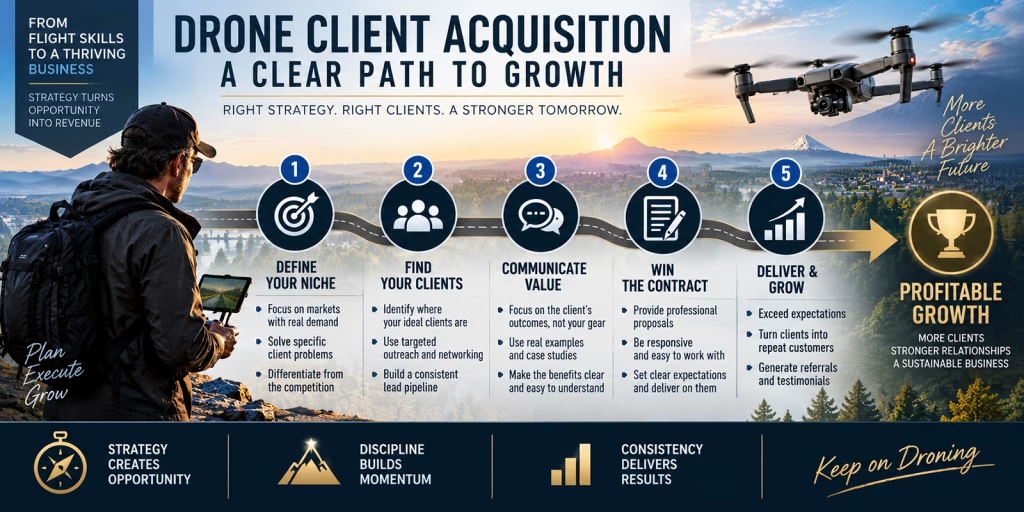
Building a sustainable drone company therefore requires more than learning how to operate drones. It requires understanding markets, customers, positioning, differentiation, pricing, sales, customer retention, and profitability. That’s the fundamental business equation: Drone Skills + Business Strategy = Greater Probability for Profitability.
One Industry Challenge You Can Actually Influence
The Global State of Drones 2026 portrays an industry still heavily influenced by forces outside the control of individual operators. Regulatory obstacles rank as the industry’s largest challenge, while 58% of respondents identified rule-making authorities as important market-driving actors. Drone Industry Insights notes that regulatory restrictions and uncertain timelines can place companies under pressure as they wait for opportunities to scale.
A small drone company cannot rewrite aviation regulations. It cannot control international trade policy, geopolitical events, or what manufacturers decide to build next. Client acquisition is different. A business owner can choose a market, study prospective customers, specialize, improve the offer, change positioning, strengthen the sales process, develop recurring relationships, and reduce dependence on price competition.
Perhaps most importantly, drone companies can stop thinking primarily about selling drones and begin thinking about selling solutions to business problems. Those decisions won’t guarantee success, but unlike many of the external challenges confronting the drone industry, they are decisions the entrepreneur can actually make.
The drone industry may indeed have a client acquisition problem. For individual drone entrepreneurs, however, that problem also represents a significant business strategy opportunity. Instead of asking only, “How do I find more drone customers?” perhaps the better question is: “What business problem can I solve well enough that the right customers have a reason to find—and keep—me?” That’s a fundamentally different way of thinking about the drone business, and it may be one of the most important differences between simply owning a drone company and building one that lasts.
Takeaway
Here’s something experienced business owners eventually learn, and we’re willing to share it: the best client-acquisition strategy is not continually acquiring new clients. It’s becoming increasingly valuable to the good clients you already have. The first job may come from marketing, networking, SEO, a referral, or even luck, but the real business begins after that first invoice is paid. Learn what else your client struggles with, anticipate what they’ll need next, make their job easier, and give them fewer reasons to shop around. A $300 customer who hires you once is a transaction; that same customer who calls six times a year, refers two colleagues, and trusts you with increasingly valuable work is a business relationship. So don’t measure client acquisition only by how many new names enter your pipeline. Measure it by how many customers eventually stop looking for someone else.
If you have any questions, let us know! If you’d like to hire us, you can get more information here.
Written by: Tony Marino, MBA – FAA Certified Part 107 Commercial Drone Pilot and Chief Business Strategist at Aerial Northwest
This article is intended for business-strategy and educational purposes and does not constitute legal advice. Real estate advertising laws and MLS requirements vary by jurisdiction. Photographers and real estate media providers should review the rules applicable to the markets in which they operate and consult qualified legal counsel when appropriate.
About the Research
The Global State of Drones 2026 was produced by Drone Industry Insights and authored by Hendrik Bödecker and Kay Wackwitz. The ninth annual Drone Industry Survey was conducted from June through August 2026 and collected 548 responses from companies across 61 countries.
Europe accounted for 48% of respondents, North America 23%, and Asia 15%. The service sector represented 67.5% of respondents and included drone operations, consulting, training, engineering, and public media. These demographics are important because the findings represent a global industry survey rather than a study specifically of U.S. Part 107 drone service providers.
Source: Bödecker, H., & Wackwitz, K. (2026). Global State of Drones 2026: New Trends and Perspectives of the Commercial Drone Industry Based on a Direct Surveying of Global Drone Companies. Drone Industry Insights, Hamburg, Germany.
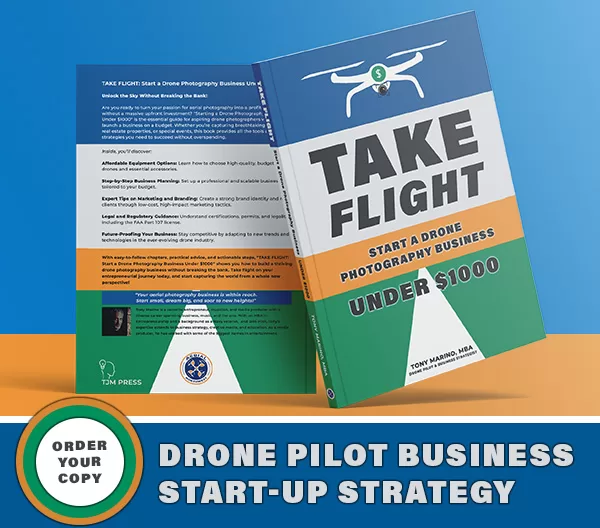
Starting Your Own Drone Service Business
Pick up your copy today on Amazon and wherever fine books are sold.

DRONE BUSINESS STRATEGY MAGAZINE
A free digital publication made exclusively for all small business drone pilots to them help start-up, become profitable while sustaining a competitive advantage within the drone service industry sector they opt to serve.
“If you love to fly, we’d love to have you come aboard!”
We share your information with no one. Our Privacy Policy.







Leave a reply
Your email is always safe with us.