

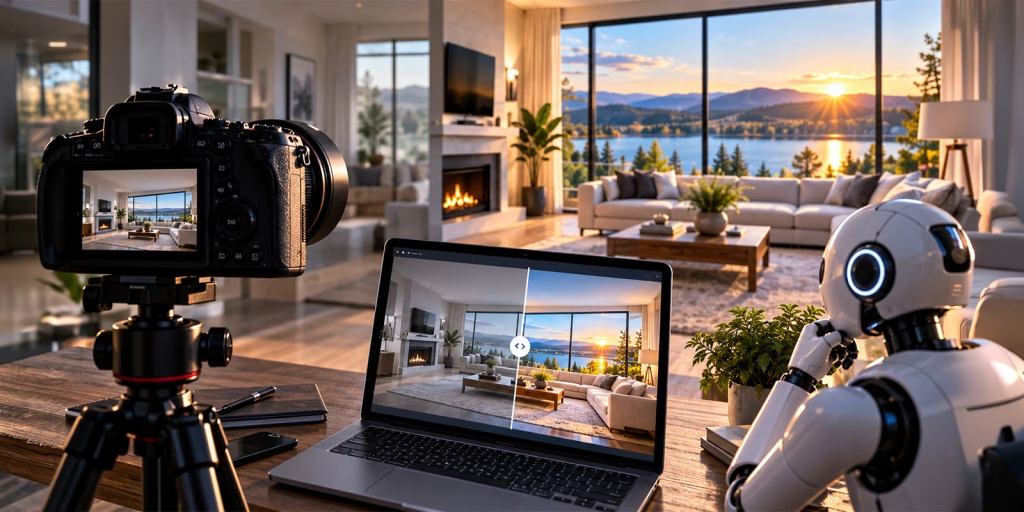
Artificial intelligence has made something extraordinarily easy that professional real estate photographers have wrestled with for decades: changing reality.
Removing a trash can once required Photoshop skills. Replacing a brown lawn took time. Removing power lines required careful retouching. Changing flooring, repainting walls, eliminating furniture, replacing landscaping or completely remodeling a kitchen digitally required considerable expertise.
Today, some of those changes can be accomplished with a sentence.
That creates an enormous opportunity for real estate photographers—but it also creates a rapidly growing business risk.
The question is no longer simply, “Can I make this photograph look better?”
The better question is:
“Does this photograph still truthfully represent the property being offered for sale?”
For drone pilots and real estate media professionals, that distinction may become one of the most important strategic issues affecting the industry over the next several years.
This isn’t an argument against AI.
It’s an argument for developing a business strategy around it.
WHO Needs to Pay Attention?
Virtually anyone involved in creating, approving, distributing or publishing real estate imagery.
That includes:
- Real estate photographers
- Commercial drone pilots
- Real estate media companies
- Virtual-staging providers
- Photo editors
- Videographers
- Real estate agents and brokers
- MLS organizations
- Property marketing companies
- Developers and builders
But photographers and drone operators occupy an especially interesting position.
We are frequently the people actually creating the marketing assets.
An agent may request:
- “Can you remove those power lines?”
- “Can you make the lawn greener?”
- “Can you get rid of that neighboring building?”
- “Can you remove the stains from the roof?”
- “Can AI clean up the backyard?”
Five years ago, some requests were impractical or expensive enough that photographers could simply say no.
AI has eliminated much of that friction.
That means our judgment—not technological capability—has increasingly become the limiting factor.
And that’s where business strategy enters the picture.
WHAT Is Actually Changing?
Professional real estate photography has always involved editing.
A RAW photograph straight from a camera is rarely the finished product.
Photographers routinely adjust exposure, contrast, white balance, highlights and shadows, color, sharpening, noise, perspective, lens distortion, vertical alignment and cropping.
Those processes generally improve the photograph without materially changing the property.
AI introduces another category entirely.
It allows photographers to change the subject itself.
A useful strategic distinction is therefore:
Enhance the photograph.
versus
Alter the property.
Those are not necessarily the same activity.
California has already incorporated essentially this distinction into law. Assembly Bill 723, effective January 1, 2026, requires disclosure when a real estate broker or salesperson—or a person acting on their behalf—uses a digitally altered image in advertising or promotional material for the sale of real property. The law defines covered alterations broadly, including changes to fixtures, furniture, appliances, flooring, walls, paint color, landscaping, facades, floor plans, utility poles, neighboring properties and views through windows. It also requires access to the original, unaltered image. Importantly, the law excludes ordinary photographic adjustments such as lighting, sharpening, white balance, color correction, angle, straightening, cropping and exposure when they do not change the representation of the property.
California AB 723:
https://leginfo.legislature.ca.gov/faces/billNavClient.xhtml?bill_id=202520260AB723
That distinction provides photographers everywhere—not merely California—with a useful framework:
Improve the image without falsifying the subject.
WHY Does This Matter to Your Drone or Photography Business?
Because this is not merely an editing issue.
It affects at least five areas of your business:
Risk. Reputation. Workflow. Client relationships. Competitive positioning.
Consider what happens when an agent asks a photographer to remove a permanent utility pole from a listing photograph.
- The photographer complies.
- The image is published.
- A prospective buyer sees the photograph, travels to the property and discovers the pole directly beside the home.
Who created the altered photograph?
You did.
Who requested it?
Perhaps the agent.
Who published it?
Possibly the brokerage.
Who might eventually become involved in explaining what happened?
Potentially everyone.
This is precisely why photographers should stop treating editing requests simply as production instructions.
Some requests are business-risk decisions disguised as Photoshop requests.
WHERE Is the Line?
There will never be a perfect universal checklist because laws, MLS requirements and brokerage policies vary.
But real estate photographers can create a practical three-zone system.
GREEN ZONE — Photographic Enhancement
These edits generally improve photographic quality without materially changing what exists:
- Exposure correction
- HDR blending
- White balance
- Sharpening
- Noise reduction
- Reasonable color correction
- Perspective correction
- Vertical correction
- Lens correction
- Cropping
- Highlight and shadow recovery
- Sensor-dust removal
The objective is simple:
Make reality look professionally photographed.
Not artificially reconstructed.
YELLOW ZONE — Visualization
This includes modifications intended to demonstrate what a property could look like rather than what it currently looks like.
Examples include:
- Virtual furniture
- Virtual staging
- Conceptual paint colors
- Alternative landscaping concepts
- Renovation concepts
- Digitally furnished vacant rooms
- Proposed construction
- Conceptual exterior improvements
These applications can provide genuine marketing value.
The key word is disclosure.
The National Association of REALTORS® emphasizes that REALTORS® should present a true picture in advertising and avoid exaggerating, concealing or misrepresenting pertinent facts. Its August 2026 guidance on AI-enhanced listing imagery urges professionals to use AI to show possibilities rather than rewrite reality.
NAR guidance:
https://www.nar.realtor/news/real-estate-news/when-does-enhancing-listing-photos-go-too-far
Virtual staging therefore shouldn’t pretend to be documentary photography.
It should communicate:
Here’s what this space could become.
That’s very different from implying:
Here’s what you’re buying.
RED ZONE — Potential Material Misrepresentation
This is where photographers should become extremely cautious.
Examples might include:
- Removing structural damage
- Digitally repairing a roof
- Eliminating permanent utility poles
- Removing neighboring structures
- Adding windows
- Enlarging rooms
- Changing permanent architectural elements
- Eliminating cracks or stains indicating property condition
- Replacing flooring
- Adding fixtures that don’t exist
- Creating nonexistent views
- Removing undesirable permanent features
- Digitally remodeling kitchens or bathrooms and presenting them as existing conditions
At that point you’re no longer merely enhancing photography.
You’re potentially manufacturing evidence of a property condition that doesn’t exist.
Some MLS organizations are already drawing firm lines here.
California Regional MLS guidance says photographs must accurately represent a property’s condition and prohibits adding, removing or modifying real property elements in ways that conflict with its truth-in-advertising rules. It requires covered digitally altered images to be labeled and the original image to appear immediately before or after the altered version.
CRMLS guidance:
https://kb.crmls.org/knowledgebase/digitally-altered-image-guidance-faqs/
RMLS in the Pacific Northwest similarly states that photographs may not contain alterations that misrepresent the property.
RMLS guidance:
https://rmlscentral.com/2023/02/22/rules-roundup-photograph-rules-changes-jan-2023/
WHEN Should You Say No to a Client?
This may be the hardest part.
Real estate photographers are service businesses. We want happy clients. And good clients often become repeat clients.
That creates pressure to say:
“Sure, I can do that.”
But profitable businesses aren’t built by saying yes to everything.
They’re built by knowing which business you are willing to accept—and which risks you aren’t willing to assume.
Before materially modifying a property image, ask:
- Does the feature actually exist?
- Is it temporary or permanent?
- Would removing or changing it affect a buyer’s understanding of the property?
- Does the applicable MLS permit the modification?
- Does state law require disclosure?
- Will the original photograph remain available?
- Has the client authorized the modification in writing?
And perhaps most importantly:
Would a reasonable buyer feel deceived after arriving at the property?
If the answer to that final question might be yes, stop.
Technology has made editing faster.
It hasn’t eliminated professional judgment.
HOW Should Photographers Fortify Their Businesses?
This is where strategy becomes operational.
Don’t merely develop an opinion about AI editing.
Develop a system.
1. Create a Written Image-Integrity Policy
Define what your company considers:
- Photographic Enhancement
- Visualization
- Material Alteration
Then establish what you will perform, what requires disclosure and what you will refuse.
This removes emotion from client conversations.
Instead of:
“I don’t like removing power lines.”
the conversation becomes:
“Our company policy prohibits removal of permanent property or environmental features from documentary listing photographs.”
That’s a business standard.
2. Put Image Alteration Into Your Client Agreement
Your photography agreement should address digital modification.
Consider establishing that routine photographic processing is included while requests involving material property alterations require separate approval and may be refused when they could violate applicable law, MLS requirements, brokerage rules or company image-integrity standards.
Your agreement should also clarify responsibility for client-requested modifications.
Have appropriate legal counsel review contractual language for your jurisdiction.
A $300 photography assignment isn’t worth inheriting a $30,000 problem.
3. Preserve Your Originals
Storage is cheap.
Disputes aren’t.
Maintain original captured photographs along with delivered versions according to a defined retention policy.
Think of the workflow as:
ORIGINAL CAPTURE → PROFESSIONAL EDIT → DELIVERED ASSET
If a question arises later, you can identify what the camera captured and what subsequently changed.
California’s requirements illustrate why this could become increasingly important: covered digitally altered real estate advertising must provide access to the original, unaltered image.
Maintaining originals isn’t merely good file management anymore.
It can become part of your risk-management strategy.
4. Document Material Client Requests
If an agent requests an unusual alteration, don’t rely solely on a telephone conversation.
Get the request in writing.
Email works. Your project management system works. A signed change request works.
The important thing is creating documentation showing:
what was requested, who requested it, what was changed, and what was delivered.
Documentation won’t transform an inappropriate alteration into an appropriate one.
But operating without documentation unnecessarily increases business risk.
5. Know the Rules Where You Operate
Don’t assume the rules governing one market apply everywhere.
Review:
- State real estate advertising regulations
- MLS photography requirements
- Brokerage requirements
- REALTOR® ethical obligations
- Virtual-staging policies
- Disclosure requirements
- Applicable AI legislation
Oregon provides a useful example. The Oregon Real Estate Agency warns licensees against materially misleading or untruthful advertising and emphasizes confirming material facts before marketing them.
Oregon Real Estate Agency guidance:
https://www.oregon.gov/rea/newsroom/Pages/2026_OREN-J/Before-You-Market-It,-Confirm-It.aspx
Photographers aren’t necessarily governed by every regulation applicable to real estate licensees.
But if your customer operates within those rules, your deliverables need to help the customer comply with them—not make compliance harder.
That’s good client service.
6. Don’t Let the Client Be Your Compliance Department
This deserves special emphasis.
A photographer shouldn’t automatically assume:
“The agent asked for it, so it must be allowed.”
- Agents are experts in selling real estate.
- Photographers are experts in producing visual media.
Neither should blindly transfer professional responsibility to the other.
If something looks questionable, investigate before delivering it.
Professional businesses develop their own standards.
FREE DOWNLOAD: Real Estate Image Integrity Checklist
Knowing where to draw the line is useful. Having a repeatable process for making that decision is better.
To accompany this article, Drone Business Strategy Magazine has created the Real Estate Image Integrity Checklist—a free four-page professional resource for drone pilots, real estate photographers and real estate media professionals.
Readers are welcome to freely download, print and use the checklist in their own real estate photography or media business.
Keep a digital copy at your editing workstation. Print copies for project files. Use the Job Record when a client requests a questionable or material alteration. Refer to the Green, Yellow and Red classifications when evaluating an edit. And use the 10-Second Image Integrity Test when you’re under deadline pressure.
The downloadable resource walks you through:
Identify the Request → Ask the Reality Question → Classify the Edit → Apply the Buyer Test → Check the Rules → Preserve the Original → Document the Decision
It also includes a working Job Record for documenting client-requested alterations and the five-question 10-Second Image Integrity Test:
- Does it exist?
- Is it permanent?
- Is it material?
- Is it disclosed?
- Would I defend it?
Download it. Print it. Use it. Keep it with your business records.
There is no charge for readers to download and use the checklist as a practical business resource.
DOWNLOAD THE FREE REAL ESTATE IMAGE INTEGRITY CHECKLIST — PDF
https://aerialnorthwest.com/wp-content/uploads/2026/09/Real-Estate-Image-Integrity-Checklist.pdf
The checklist is provided for educational and business-strategy purposes and does not constitute legal advice. Requirements vary by jurisdiction and may change.
Turn Compliance Into Competitive Advantage
Here’s where many photographers will miss the bigger opportunity.
They’ll look at emerging AI restrictions and think:
More rules. More headaches.
Strategists should see something else:
Differentiation.
As AI-generated imagery becomes easier to produce, authentic professional imagery may actually become more valuable.
Imagine being able to tell a brokerage:
“We use advanced photographic and AI technology to improve presentation while maintaining an image-integrity standard designed to protect the accuracy of your listing marketing.”
That’s stronger than:
“We shoot HDR photos.”
Nearly everybody can shoot HDR photographs.
Nearly everybody will soon have access to sophisticated AI editing.
The differentiator becomes judgment.
Your customer isn’t merely purchasing pixels.
They’re purchasing your ability to produce effective marketing assets without unnecessarily exposing their business to reputational or regulatory problems.
That’s value.
And value supports pricing.
AI Isn’t the Enemy
We should be very careful not to turn this discussion into another anti-AI argument.
AI offers tremendous possibilities for real estate marketing.
It can help with:
- Virtual staging
- Conceptual renovations
- Image organization
- Workflow automation
- Masking
- Noise reduction
- Object selection
- Color correction
- Editing assistance
- Video production
- Marketing copy
- Floor-plan visualization
- Social media production
Use it.
Learn it.
Become exceptionally good at it.
But understand what role each image is playing.
A useful distinction may eventually emerge across real estate media:
DOCUMENTARY IMAGE
This represents the property as it exists.
versus
VISUALIZATION
This represents what the property could become.
Both can sell real estate.
Both can provide value.
Both can belong in a sophisticated marketing campaign.
The strategic mistake is allowing one to impersonate the other.
Takeaway: The Horizon of Part 108
AI has dramatically reduced the cost and difficulty of manipulating photographs.
It has not reduced the consequences of misleading customers.
If anything, those consequences may increase as consumers become more skeptical of what they see online and regulators, MLS organizations and brokerages respond with stronger disclosure requirements.
That means real estate photographers should begin preparing now.
Predict.
Expect greater scrutiny of digitally altered property imagery, stronger disclosure standards and more sophisticated AI tools.
Prepare.
Establish image-integrity policies, preserve original captures, document material alterations, review client agreements and understand the requirements affecting the markets you serve.
Profit.
Position professional judgment, visual accuracy and responsible technology use as part of the value your company provides.
The future probably doesn’t belong to photographers who refuse to use AI.
Nor does it belong to photographers who use AI to make everything perfect.
It belongs to professionals who understand when technology creates value—and when it creates liability.
Before delivering your next real estate photograph, ask one simple question:
Did I improve the photograph—or did I change the property?
Knowing the difference may become one of the most valuable business skills a real estate photographer can possess.
Drone Skills + Business Strategy = greater probability for profitability.
Keep on droning.
If you have any questions, let us know! If you’d like to hire us, you can get more information here.
Written by: Tony Marino, MBA – FAA Certified Part 107 Commercial Drone Pilot and Chief Business Strategist at Aerial Northwest
This article is intended for business-strategy and educational purposes and does not constitute legal advice. Real estate advertising laws and MLS requirements vary by jurisdiction. Photographers and real estate media providers should review the rules applicable to the markets in which they operate and consult qualified legal counsel when appropriate.
Resources
Real estate photography, AI-generated imagery, virtual staging and advertising requirements are evolving quickly. Drone pilots, photographers and real estate media professionals should periodically review the rules governing the markets in which they operate.
National Association of REALTORS® (NAR)
When Does Enhancing Listing Photos Go Too Far?
https://www.nar.realtor/news/real-estate-news/when-does-enhancing-listing-photos-go-too-far
NAR Code of Ethics and Professional Standards
https://www.nar.realtor/about-nar/governing-documents/code-of-ethics
California — Assembly Bill 723
California’s AB 723 addresses digitally altered real estate advertising images, including disclosure requirements and consumer access to original, unaltered images.
https://leginfo.legislature.ca.gov/faces/billNavClient.xhtml?bill_id=202520260AB723
California Regional Multiple Listing Service (CRMLS)
Digitally Altered Image Guidance & FAQs
https://kb.crmls.org/knowledgebase/digitally-altered-image-guidance-faqs/
Regional Multiple Listing Service (RMLS)
Rules Roundup: Photograph Rules Changes
chttps://rmlscentral.com/2023/02/22/rules-roundup-photograph-rules-changes-jan-2023/
Oregon Real Estate Agency
Before You Market It, Confirm It
https://www.oregon.gov/rea/newsroom/Pages/2026_OREN-J/Before-You-Market-It,-Confirm-It.aspx
Oregon Real Estate Agency
https://www.oregon.gov/rea/
Zillow: AI-Generated Listing Photos and Why Transparency Matters
https://www.zillow.com/news/ai-generated-listing-photos-and-why-transparency-matters/
Real Estate News: AI-Modified Listing Photos Blur Line Between Enhancement, Deception
https://www.realestatenews.com/2026/09/08/ai-modified-listing-photos-blur-line-between-enhancement-deception
How Should MLSs, Portals Address AI-Enhanced Listing Photos?
https://www.realestatenews.com/2026/06/18/how-should-mlss-portals-address-ai-enhanced-listing-photos
Before You Alter the Image
When a client requests a significant modification to a listing photograph, don’t rely on AI software—or the client’s request—to determine whether the alteration is appropriate.
Check the applicable:
State law → Real estate regulations → MLS rules → Brokerage requirements → Client agreement → Your own image-integrity policy
And when you’re uncertain, preserve the original image and obtain appropriate professional or legal guidance before publishing or delivering materially altered imagery.
Technology tells us what we can change. Good business strategy helps us decide what we should change.
Resources and regulations may change after publication. Readers should verify current requirements directly with the applicable government agency, MLS, brokerage or professional organization.
Starting Your Own Drone Service Business
Pick up your copy today on Amazon and wherever fine books are sold.

DRONE BUSINESS STRATEGY MAGAZINE
A free digital publication made exclusively for all small business drone pilots to them help start-up, become profitable while sustaining a competitive advantage within the drone service industry sector they opt to serve.
“If you love to fly, we’d love to have you come aboard!”
We share your information with no one. Our Privacy Policy.






Leave a Reply
Your email is always safe with us.