


A Structural Framework for Predictable Drone Business Growth: In today’s commercial drone marketplace, technical capability is no longer a meaningful differentiator. Most professional drone operators use comparable aircraft, similar cameras, and overlapping service offerings. Yet performance across businesses varies dramatically. Some drone companies close contracts consistently, protect their pricing, and scale revenue predictably. Others work tirelessly, send proposals regularly, and network aggressively, yet struggle to convert opportunities into signed agreements.
The difference is not effort. It is structure.
Many drone entrepreneurs assume growth requires increased activity—more outreach, more follow-ups, more proposals. However, when close rates fail to improve despite increased effort, the constraint is rarely activity itself. The constraint is architectural. Sales outcomes are governed by structure, not hustle.
Sustainable drone business growth can be understood through what I call The 5 Forces Sales Strategy™. This framework identifies five structural forces that determine whether proposals close or stall. These forces are: Positioning, Diagnostics, Conviction, Friction, and Commitment. Together, they form the load-bearing walls of a revenue system. When one weakens, performance declines. When all five are aligned, closing becomes easier, faster, and more predictable.
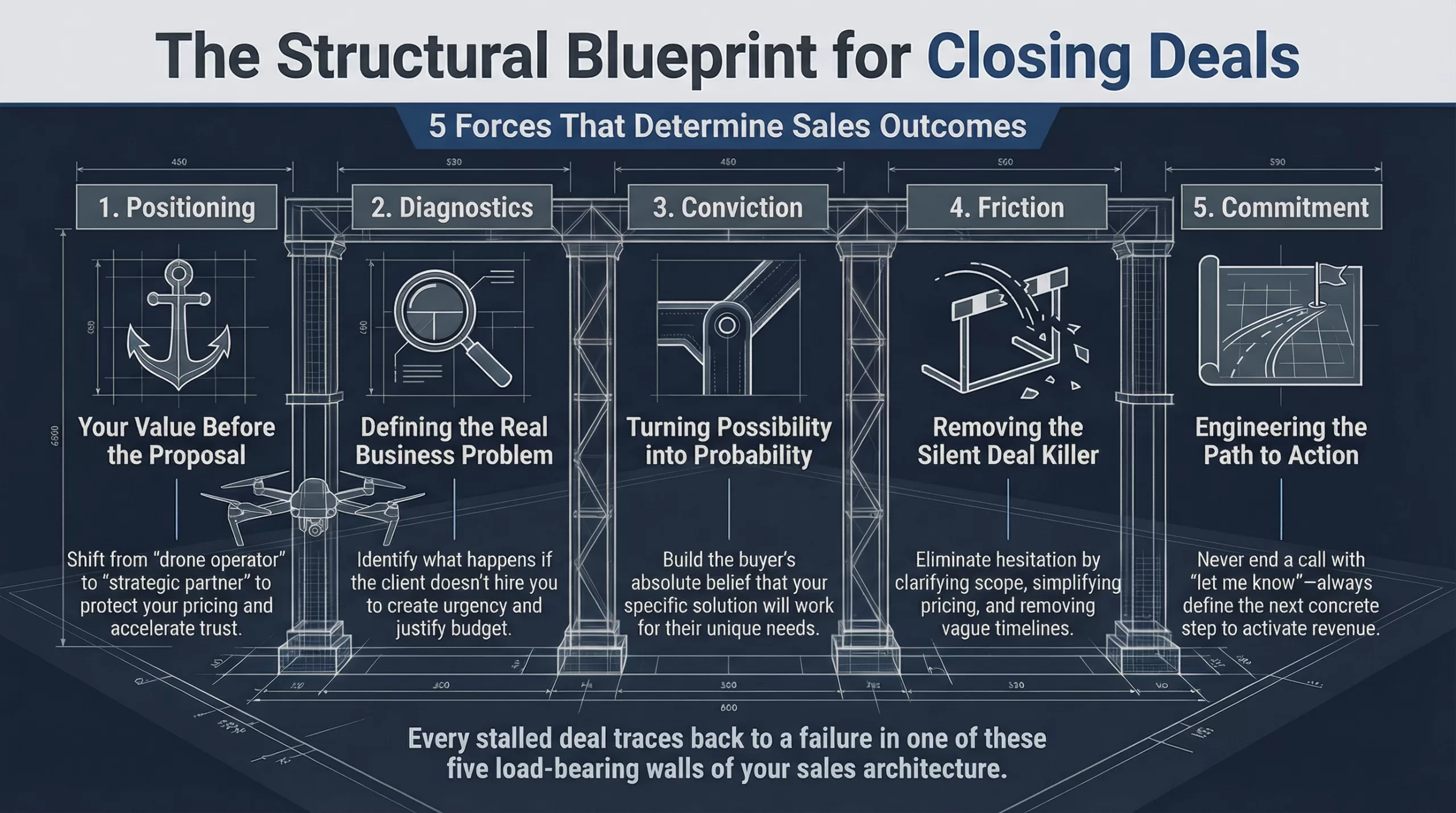
1. Positioning: The Foundation of Pricing Power
Positioning is what your client believes about you before you ever send a proposal. It determines whether you are perceived as a commodity operator with a drone or as a strategic aerial solutions partner solving business problems.
Strong positioning protects pricing, accelerates trust, reduces competitive bidding, and provides access to real decision-makers. Weak positioning, on the other hand, creates price pressure and comparison shopping. If the first question you hear in a conversation is, “What’s your rate?” that is not primarily a budget issue—it is a positioning issue.
Positioning determines whether you are evaluated on value or compared on cost.
2. Diagnostics: Defining the Real Business Problem
Diagnostics is your ability to identify and articulate the true business problem beneath the surface request. When a client says they need aerial footage, that request is rarely the ultimate objective. The underlying goal may involve reducing liability, improving investor reporting, accelerating property sales, increasing operational efficiency, or mitigating risk.
Strong diagnostics create urgency because they clarify consequences. They justify budget allocation and align stakeholders around measurable outcomes. Weak diagnostics reduce your proposal to a line item in a broader budget. If you cannot clearly articulate what happens if the client does not move forward, diagnostic force is weak—and without urgency, decisions drift.
3. Conviction: Converting Interest into Belief
Conviction is not the same as interest. It is belief. It is the buyer’s confidence that your specific solution will produce results in their specific environment.
Strong conviction transforms a deal from possibility to probability. It reduces internal resistance, shortens decision cycles, and strengthens deal resilience. If you frequently hear, “Let me think about it,” conviction has not yet been established.
Conviction is built through relevance, clarity, and proof. It requires connecting your service to tangible business outcomes and reducing perceived risk. Without conviction, hesitation becomes the default response.
4. Friction: The Invisible Resistance
Friction is the silent deal killer. It rarely presents itself as a direct objection. Instead, it shows up as hesitation or delay.
Common sources of friction include unclear scope, complicated pricing structures, vague timelines, undefined deliverables, and stakeholder misalignment. Even when verbal agreement exists, friction can stall momentum. Reducing friction increases deal velocity. The clearer and simpler the path forward, the faster revenue activates.
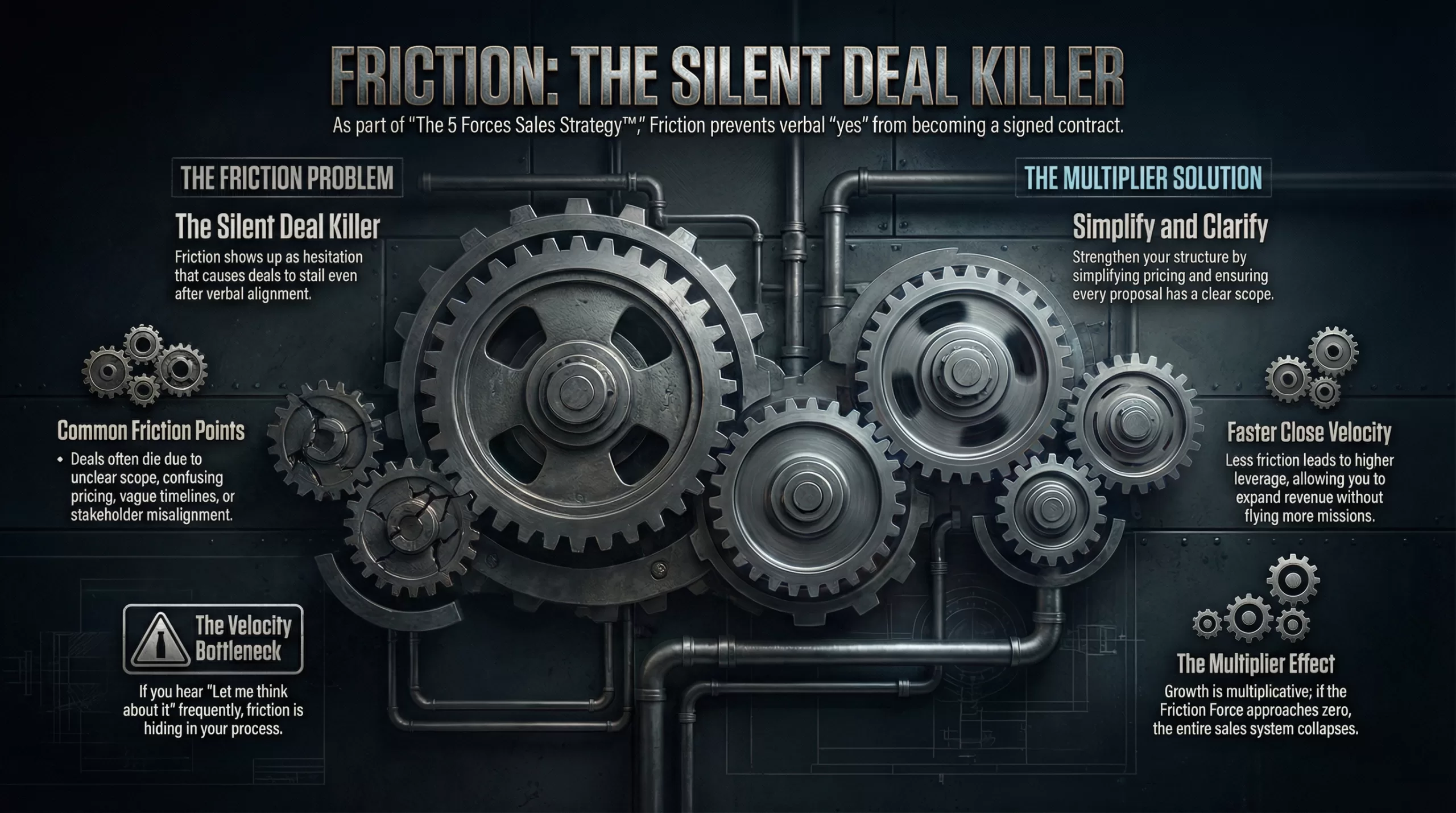
5. Commitment: Engineering Action
Commitment is the engineered transition from agreement to action. Alignment is agreement in principle. Commitment is agreement in execution.
Strong commitment defines next steps, clarifies timelines, assigns responsibilities, and initiates onboarding. Weak commitment leaves momentum to chance. If a sales call ends without a defined next step, commitment has not been secured.
Revenue does not activate through verbal agreement alone. It activates through structured commitment.
The Multiplier Effect: Why Structure Outperforms Effort
The most important insight in this model is that growth is not additive—it is multiplicative.
Additive growth relies on increasing activity: more calls, more emails, more proposals. It assumes that doubling effort will double results.
Multiplicative growth strengthens the system itself. It recognizes that each of the five forces interacts with the others.
Sustainable Sales Growth can be expressed as:
Positioning × Diagnostics × Conviction × Friction Mitigation × Commitment Clarity
If any one force approaches zero, the overall outcome collapses. Strong positioning cannot compensate for weak diagnostics. Clear diagnostics cannot overcome weak conviction. High conviction cannot survive excessive friction. Alignment without structured commitment results in stalled deals.
When even one weak force is strengthened, the entire system improves. That is leverage. Additive growth makes you busier. Multiplicative growth makes the system better—and better systems scale.
A Practical Illustration
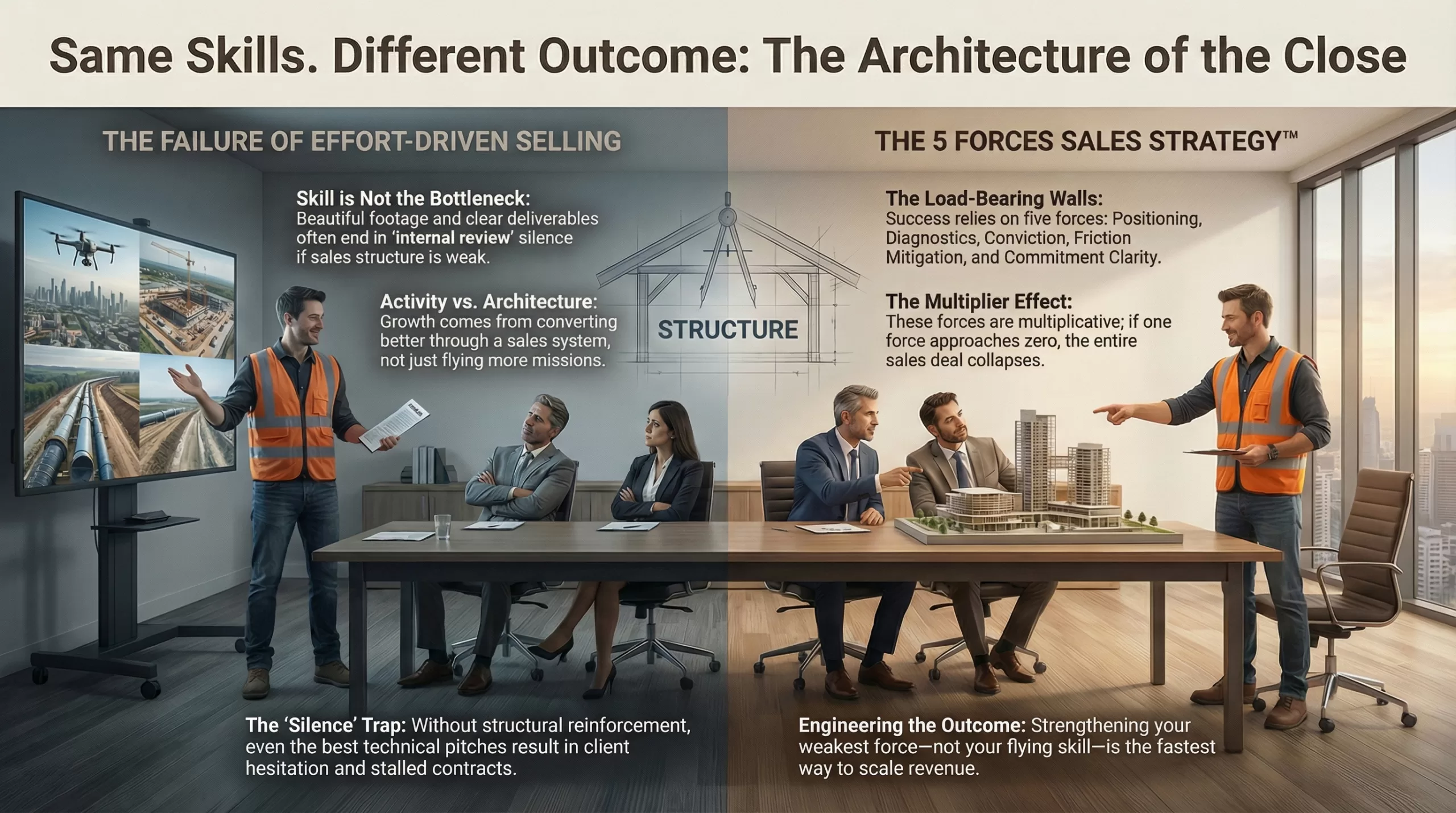
Consider a $30,000 construction progress contract. The drone operator presents high-quality footage and outlines deliverables clearly. The client responds positively but concludes with, “Looks good. We’ll review internally.” Weeks pass without resolution.
The failure was not technical capability. It was structural weakness—likely in diagnostics, conviction, friction reduction, or commitment design.
Now imagine the same scenario with strengthened forces: urgency tied to project deadlines, clearly defined financial implications of delay, relevant case studies, simplified scope, and a defined next step before the call ends. The contract closes.
Same drone. Same skills. Different structure.
Takeaway: The Strategic Conclusion
Drone entrepreneurs often believe growth comes from flying more jobs. In reality, growth comes from converting better. Flight skill builds credibility. Sales structure builds scale.
You cannot control weather conditions, regulatory changes, or competitor pricing. But you can control the architecture of how you close deals.
Closing more contracts is not something you chase. It is something you engineer.
And the strength of that engineering determines whether your drone business remains dependent on hustle—or evolves into a scalable revenue system.
If you have any questions, let us know! If you’d like to hire us, you can get more information here.
Written by: Tony Marino, MBA – FAA Certified Part 107 Commercial Drone Pilot and Chief Business Strategist at Aerial Northwest
Disclaimer: The information provided in this blog post is for general informational purposes only and should not be construed as legal advice.
Drone Pilot MBA Series
Why Drone Pilots Fail to Close Deals — and the 5 Forces That Fix It

Resources
FAA Resources: FAA DroneZone
Article: What Does it Mean to Decode the Drone Industry?
Article: Pitch Perfect: Guide for Drone Pilots to Get Jobs
Drone Business Strategy Magazine (Study Report):
PESTEL Analysis: A Critical Tool for Commercial Drone Pilots
Drone Business Strategy Magazine (Study Report):
Drone Pilot SWOT Analysis: The Key to Commercial Success
Starting Your Own Drone Service Business
Pick up your copy today on Amazon and wherever fine books are sold.

DRONE BUSINESS STRATEGY MAGAZINE
A free digital publication made exclusively for all small business drone pilots to them help start-up, become profitable while sustaining a competitive advantage within the drone service industry sector they opt to serve.
“If you love to fly, we’d love to have you come aboard!”
We share your information with no one. Our Privacy Policy.






Leave a Reply
Your email is always safe with us.