

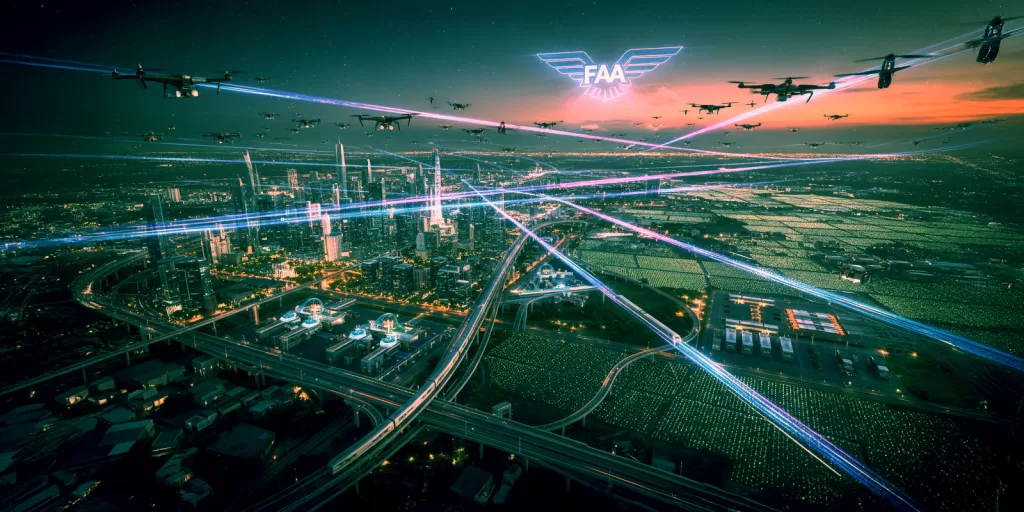
Imagine a world where drones are no longer limited by the sky’s boundaries. What if the FAA’s latest rules could turn that dream into reality? From bypassing pilot licenses to creating drone highways, these surprising changes could unlock a future where drones transform industries at scale. Keep reading to discover how the FAA’s groundbreaking proposal is set to unleash drones across America—and why it’s a game changer you can’t afford to miss.
Introduction: Breaking the Regulatory Logjam
Drones are no longer a novelty; they are a common sight in our skies, used for everything from stunning aerial photography to basic site mapping. However, their true potential for transformative services like large-scale infrastructure inspection and automated package delivery has been largely grounded by a single, persistent limitation: the requirement for an operator to keep the aircraft within their visual line of sight.
This isn’t just an inconvenience; it’s a fundamental barrier to scalability. For the third consecutive year, the drone industry has identified “Regulatory obstacles” as its top challenge. The current system, which relies on a patchwork of individual waivers and exemptions, is simply not built for the future.
Now, the Federal Aviation Administration (FAA) has released a landmark Notice of Proposed Rulemaking (NPRM) that aims to change everything. This proposal is designed to create a “repeatable, scalable regulatory framework” for Beyond Visual Line of Sight (BVLOS) operations. But hidden within this dense legal document are several surprising, counter-intuitive, and revolutionary shifts in thinking. Here are the six most impactful takeaways that could finally unleash the full potential of drones across America.
1. Forget the Pilot’s License: Responsibility Is Shifting from People to Companies
The proposed rules do not require an “airman certificate”—the equivalent of a pilot’s license—for the personnel operating the drones. This is a profound departure from traditional aviation, where the licensed pilot in command is the ultimate authority. The FAA’s rationale is that as drone systems become more autonomous, the direct, hands-on role of the human pilot diminishes. Technology, not moment-to-moment human intervention, is becoming the primary guarantor of safe operation.
Under this proposal, the ultimate responsibility for safety shifts from the individual “pilot” to the operating company as a whole. The company, not a certificated individual, is responsible for ensuring its personnel have the necessary knowledge and skills. A fascinating and surprisingly specific detail is that all drone operations must be “monitored and controlled from a location that is physically located within the United States,” a rule that ensures FAA oversight and addresses national security concerns by preventing operations from being run from anonymous overseas locations.
With the increasing autonomy of UAS, particularly those anticipated for use under this proposal, the role of the pilot has and will continue to decrease. The UAS industry has increasingly come to rely on technology, rather than human interaction or intervention, to ensure safe operation.
This shift allows companies to develop bespoke training programs tailored to their unique drones and operational needs. For a national retailer, this means they can train their logistics staff on the specifics of their delivery drone system without having to send them to get a generic aviation certificate. This could dramatically accelerate the deployment of new and innovative drone services by aligning training directly with the technology being used.
2. A Fast Lane for Drone Approval: Bypassing Traditional Aircraft Certification
Traditional aircraft must pass through a lengthy and expensive “type certification” process before they can fly. This system is ill-suited for the drone industry, where technology evolves so rapidly that “a particular model of UAS may only be produced for a matter of months” before a new version is released. This rapid approval pathway is crucial because the very autonomy driving the shift away from pilot’s licenses (as discussed in Point #1) is evolving at a breakneck pace.
The FAA’s proposed solution is a streamlined “airworthiness acceptance” process. Instead of conducting a deep, multi-year review of every new drone design, the FAA would allow a manufacturer to submit a “Declaration of Compliance” (DOC). This document attests that their drone was designed and built according to FAA-accepted industry consensus standards.
A lengthy approval process would not only slow advancement, but the costs would be greater to implement design improvements. Thus, the airworthiness acceptance, as proposed under part 108, will allow the use of industry consensus standards and a streamlined acceptance process.
This change creates a “more time and resource appropriate avenue” for getting safe, new technology into the skies. It allows the regulatory framework to keep pace with innovation, meaning a drone manufacturer can release an improved model with better sensors or a longer-lasting battery every six months, getting it approved and into service in a fraction of the time it would take for a manned aircraft.
3. Private “Air Traffic Control”: The Rise of Automated Data Services
The FAA has made it clear that it does not plan to extend its traditional Air Traffic Control (ATC) services to manage the thousands of low-altitude drone flights expected in the coming years. The existing radar-based system is simply not designed for it. With Point #2’s fast lane potentially enabling a Cambrian explosion of new drone models, a new traffic management solution is essential.
Instead, the proposal introduces a new regulatory framework for certifying private “Automated Data Service Providers.” These companies will form the backbone of a new digital air traffic management system for drones. They will be certified to offer two key services:
- Strategic Deconfliction: Think of this as a route reservation system. Before a flight, an operator’s software will communicate with a service provider to ensure its intended 4D path (latitude, longitude, altitude, and time) doesn’t conflict with other planned drone flights.
- Conformance Monitoring: This is a real-time service that ensures a drone is sticking to its planned route. If the unmanned aircraft deviates, the service provider automatically sends out alerts to the operator and other nearby airspace users.
Imagine a future where companies like Google, Amazon, or specialized startups like SkyGrid compete to offer the most efficient “drone highways” over a city, optimizing routes for speed, energy consumption, and noise avoidance. This rule builds the regulatory foundation for that very marketplace, establishing a core component of the much-anticipated Unmanned Aircraft System Traffic Management (UTM) ecosystem.
4. Drones Get the Right-of-Way (But Only in Very Specific Situations)
The general rule for air traffic is simple and unchanged by this proposal: unmanned aircraft (UA) must yield the right-of-way to all manned aircraft. But the new rule carves out a surprising and highly practical exception for drones operating in “shielded areas.” These zones are naturally deconflicted and represent a space where the privatized traffic services from Point #3 may not be necessary.
The FAA proposes to give drones the right-of-way when they are operating within 50 feet of specific infrastructure, such as power lines, pipelines, bridges, and railroads (provided they have permission from the infrastructure owner).
This is a clever solution that directly enables critical inspection work. The FAA’s rationale explicitly notes that these shielded operations reduce the significant risks associated with helicopter inspections of power lines and pipelines. Picture a drone flying just a few feet from a high-voltage line, capturing high-resolution imagery to detect faults. By giving the drone priority in this very narrow, predictable airspace, the FAA makes this essential work dramatically safer and more efficient than sending up a human crew in a helicopter.
5. One Operator, Many Drones: The Key to Scalability
For services like package delivery or large-area agricultural spraying to be economically viable, a single operator must be able to manage a fleet of drones, not just one at a time. The proposed rule explicitly builds a pathway to make this a reality. This move towards one-to-many operations is the logical endpoint of the FAA’s decision in Point #1 to shift safety responsibility from individual pilots to the company’s holistic system.
While the default ratio of flight coordinators to drones is 1:1, the rule allows operators to seek authorization for a higher ratio. This would be determined by the manufacturer’s tested system capabilities and the operator’s own FAA-accepted procedures. The key is demonstrating that the system’s level of automation and its “Simplified User Interaction (SUI)” allow a single person to safely manage multiple aircraft simultaneously.
This is the rule that separates a boutique drone service from a national logistics network. It’s the difference between one person flying one drone to deliver a single pizza and a single flight coordinator at a logistics hub overseeing fifty drones simultaneously delivering packages across an entire suburb. This provision directly enables the economies of scale that companies like Zipline and UPS Flight Forward have been planning for.
6. Flying Over People Will Be Governed by Data-Driven Population Maps
The new rules move beyond vague prohibitions on flying over people and create a sophisticated, data-driven framework for assessing and mitigating ground risk. This granular approach is what makes the large-scale fleets envisioned in Point #5 possible over populated areas. The system is built around five “Population Density Categories,” ranging from Category 1 (very low density, like remote rural areas) to Category 5 (very high density, like major metropolitan downtowns).
To ensure consistency, the FAA proposes that all operators use a specific, publicly available data set called “LandScan USA” to determine which category a given area falls into. This removes ambiguity and creates a level playing field.
The rules then directly link risk to requirements. Operations in lower-risk areas (Categories 1-3) can be conducted with a simpler “operating permit.” To fly in higher-density areas (Category 4 and 5), an operator must obtain a more stringent “operating certificate,” which involves deeper FAA oversight and requires a formal Safety Management System (SMS).
This risk-based approach allows a pharmacy to seek a permit for a delivery network across a suburban town (Category 3), using LandScan data to prove their routes avoid dense areas. Meanwhile, a company wanting to deliver in downtown Chicago (Category 5) would need a full certificate, undergoing intense FAA scrutiny. It’s a pragmatic system that unlocks massive economic potential in lower-risk areas while ensuring the highest level of safety where it matters most.
Takeaway: A New Framework for the Skies
Taken together, these six points reveal a clear, overarching theme: the FAA is proposing a flexible, scalable, and risk-based framework designed to finally integrate BVLOS drone operations into the national airspace.
The proposal represents a major philosophical shift away from the traditions of manned aviation. It embraces reliance on technology over direct human control, places responsibility on organizations rather than on individual certificate holders, and favors performance-based standards over rigid, prescriptive rules.
It is important to remember that this is still a proposed rule and is open for public comment before it becomes final. But the direction is clear. This new framework is poised to break the regulatory logjam that has held the industry back.
If these rules become reality, what new drone applications that seem like science fiction today will become commonplace tomorrow?
If you have any questions, let us know! If you’d like to hire us, you can get more information here.
Written by: Tony Marino, MBA – FAA Certified Part 107 Commercial Drone Pilot and Chief Business Strategist at Aerial Northwest
Disclaimer: The information provided in this blog post is for general informational purposes only and should not be construed as legal advice.
Resources
FAA Resources: FAA DroneZone
Article: What Does it Mean to Decode the Drone Industry?
Article: Pitch Perfect: Guide for Drone Pilots to Get Jobs
References
Federal Aviation Administration. (n.d.). Notice of Proposed Rulemaking for Beyond Visual Line of Sight (BVLOS) Operations (Proposed Rule).
Federal Aviation Administration. (n.d.). Unmanned Aircraft System Traffic Management (UTM) Ecosystem Framework (Based on automated data services certification).
Industry. (n.d.). Industry Consensus Standards (as accepted by the FAA).
Oak Ridge National Laboratory. (n.d.). LandScan USA.
Starting Your Own Drone Service Business
Pick up your copy today on Amazon and wherever fine books are sold.

DRONE BUSINESS STRATEGY MAGAZINE
A free digital publication made exclusively for all small business drone pilots to them help start-up, become profitable while sustaining a competitive advantage within the drone service industry sector they opt to serve.
“If you love to fly, we’d love to have you come aboard!”
We share your information with no one. Our Privacy Policy.






1 Comment
Leave your reply.