

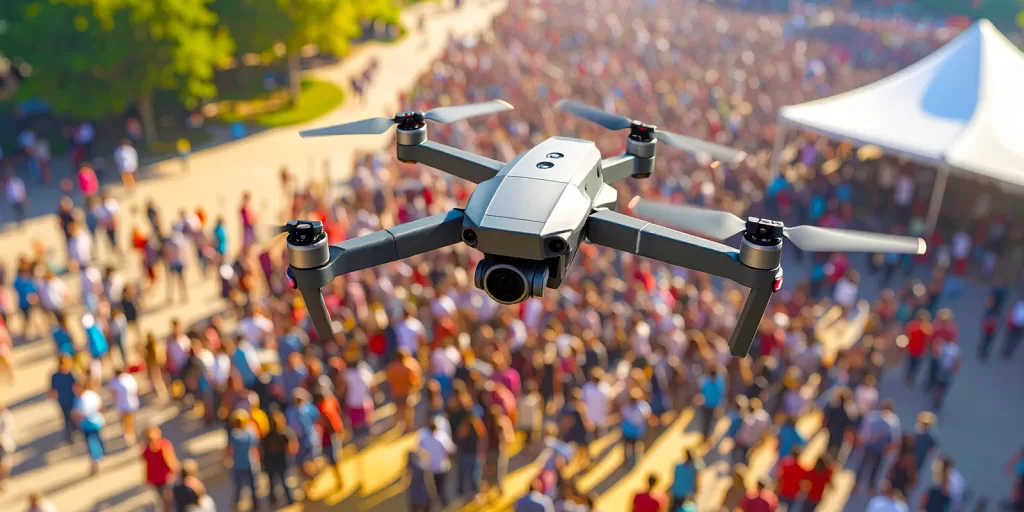
On September 10, 2025, Charlie Kirk, a prominent conservative activist, was fatally shot during his appearance at Utah Valley University (UVU). Early reports indicate that Kirk had received multiple death threats in the weeks leading up to the event. Security personnel were present, yet the attack occurred from a vantage point that left critical gaps exposed—a rooftop approximately 200 yards from the stage.
As commercial drone operators, security analysts, and technology advocates, we cannot help but ask: why wasn’t a drone in the air?
The conditions were permissive for such a deployment. At the time of the shooting, no Temporary Flight Restriction (TFR) was in effect, meaning Class D airspace up to 400 feet was available for commercial drone operations. Drones capable of supporting surveillance, such as a DJI Mini, are affordable, costing under $500. Obtaining a Part 107 remote pilot license is accessible, with the study process free and the test costing less than $200. Liability insurance for a small operation is inexpensive, typically under $100. Even if the event organizers lacked in-house capabilities, contracting a licensed drone operator could have been arranged for less than $100 per hour.
Given the combination of an existing credible threat, open airspace, and affordable technology, the absence of drone deployment raises questions about planning, preparedness, and the broader integration of drones into protective operations.
The Case for Drone Deployment
Drones are uniquely suited to supplement traditional security measures. They provide elevated perspectives, the ability to cover blind spots inaccessible to ground personnel, and real-time video feeds that can inform security teams of unusual activity. In this scenario, drones could have:
1. Enhanced Situational Awareness
By patrolling rooftops, open spaces, and perimeter zones, drones could have given security teams live insight into potential vantage points for attacks.
2. Deterrence
The visible presence of drones can dissuade potential attackers. Even a minimal aerial footprint signals that the event is being actively monitored, potentially causing a perpetrator to reconsider timing or approach.
3. Rapid Response Support
Real-time video allows security personnel to direct immediate responses more effectively, whether that means evacuation, lockdown, or interception.
4. Forensic Documentation
In the aftermath of an attack, drone footage provides a detailed record of events, vantage points, and suspect movement. This evidence is invaluable for investigations, prosecution, and risk assessment for future events.
Given these advantages, the question becomes: why were drones not utilized, especially when barriers—regulatory, technical, and financial—were minimal?
The Counter-Argument: Why Drones May Not Have Prevented the Shooting
While drones offer significant benefits, it is important to recognize their limitations. Critics may argue that even if a drone had been deployed, it might not have prevented the tragedy. Key considerations include:
1. Line-of-Sight Challenges
Drones are limited by what cameras can detect. A shooter concealed behind HVAC units, roof ledges, or vents may not be visible, particularly if they remain prone or stationary until firing. Detection is only as good as the drone’s vantage point and the skill of the operator.
2. Coverage and Endurance
Small drones have finite battery life, typically 20–30 minutes per flight for models like the DJI Mini. Continuous coverage requires multiple aircraft and operators. A single drone patrolling intermittently may miss critical activity on rooftops or behind obstructions.
3. Operational Complexity
Launching a drone is straightforward; integrating drones into a live security operation is not. Effective use requires trained personnel monitoring live feeds, seamless communication with on-the-ground security teams, and clear response protocols. Without these systems, valuable surveillance may arrive too late to prevent a first shot.
4. False Sense of Security
There is a danger that the presence of a drone could create a false sense of security. Security teams may assume that aerial coverage is sufficient, while other vulnerabilities—such as gaps in perimeter checks, crowd screening, or rooftop surveillance—remain unaddressed.
5. Shooter Advantage
Even if spotted moments before firing, a sniper on a rooftop has a temporal advantage. Depending on distance, line-of-sight, and reaction time, the shooter could still fire before security personnel are able to respond. Drones detect but do not neutralize threats.
6. Institutional Hesitation
While regulatory and financial barriers were low, institutional barriers may have been significant. Event organizers and university administrators may hesitate to authorize drones over crowds due to liability concerns, safety considerations, or privacy issues. Security teams may default to traditional protective measures rather than deploying what might be perceived as an “experimental” or untested tool.
Drone Deployment Cost & ROI Analysis – UVU Event
Even small drones can provide substantial value in event security, especially when credible threats exist. Here’s a practical breakdown of what a modest deployment could have looked like for the Utah Valley University event:
Item
DJI Mini Drone
Part 107 Remote Pilot License
Liability Insurance
Extra Battery Pack
Optional Drone Operator (Contracted)
Total Investment
Estimated Cost
$499
$200
$100
$100
$100/hr
~$999
Notes / Assumptions
Commercial-ready, 30-min flight per battery
One-time licensing cost; study materials free
Event-specific, short-term coverage
Ensures ~1.5–2 hours of continuous flight per drone
Could cover the event duration, ~2–3 hours
Includes equipment, insurance, and operator
Potential ROI / Value
1. Deterrence of Attackers: Visual presence of drones could have discouraged rooftop or concealed threats.
2. Situational Awareness: Real-time video monitoring allows security teams to identify suspicious activity before an incident occurs.
3. Forensic Evidence: Video recording of vantage points, entry/exit points, and suspect movement is invaluable post-incident.
4. Public Confidence & Perception: Demonstrates proactive security measures, which can enhance trust in organizers and institutions.
5. Scalable & Reusable: Equipment investment is not one-off; drones and trained operators can be deployed across future events, providing long-term value.
Bottom Line: For under $1,000, event organizers could have deployed a cost-effective aerial surveillance solution capable of deterring threats, enhancing situational awareness, and providing forensic documentation. In terms of risk mitigation and potential lives saved, the ROI is enormous.
The Missed Opportunity
Acknowledging limitations does not absolve the absence of drones. The tragedy at UVU demonstrates the consequences of failing to fully leverage available technology. While drones cannot guarantee prevention, they could have strengthened deterrence, improved situational awareness, and provided critical forensic evidence. At minimum, their presence overhead could have forced the shooter to reconsider timing or approach.
The incident underscores a broader lesson for the drone industry: technology alone is insufficient. Effective deployment requires integration into a layered security strategy that accounts for coverage gaps, operational limitations, and response protocols.
The Path Forward for Security and Drones
Security doctrine must evolve to meet modern threats. Traditional methods—metal detectors, bag checks, static personnel—are insufficient against long-range or elevated attacks. Drones offer a cost-effective and versatile tool that should be part of a comprehensive security plan, particularly in situations where credible threats exist.
For the drone industry, this represents both a challenge and an opportunity:
1. Educate Event Organizers: Demonstrate how drones can augment traditional security measures in a cost-effective, low-risk manner.
2. Train Operators for Security Integration: Beyond piloting, operators must understand tactical surveillance, real-time communication, and operational coordination with security teams.
3. Develop Multi-Drone Protocols: Sustained aerial coverage requires multiple aircraft and clear rotation strategies to mitigate battery and coverage limitations.
4. Advocate for Inclusion in Security Plans: Drones must be considered standard in events with known threats, bridging the gap between situational awareness and preventative security measures.
Takeaway
The tragedy at Utah Valley University is a sobering reminder that traditional security measures alone are no longer sufficient. Drones offer a practical, affordable, and increasingly necessary layer of protection, deterrence, and evidence collection. Their absence in this case highlights both a missed opportunity and a critical lesson for the industry.
The reality is simple: drones may not have stopped the first shot, but without them, security teams were operating in blind spots that technology could have illuminated. For drone entrepreneurs, commercial operators, and security strategists, the takeaway is clear: our technology is not just for real estate marketing, aerial cinematography, or infrastructure inspection. It has a critical role in public safety—and it is time to make that case professionally, strategically, and urgently.
The stakes are higher than ever. The question is no longer whether drones can be integrated into security strategies—it’s whether security leadership and industry professionals will act before another preventable tragedy occurs.
Godspeed to Charlie, his wife and children, his parents and family, and all who consider every life sacred as one nation under God.
If you have any questions, let us know! If you’d like to hire us, you can get more information here.
Written by: Tony Marino, MBA – FAA Certified Part 107 Commercial Drone Pilot and Chief Business Strategist at Aerial Northwest
Disclaimer: The information provided in this blog post is for general informational purposes only and should not be construed as legal advice.
Drone Pilot MBA Series
Honoring Charlie Kirk: Drones for Safer Events

Resources
FAA Resources: FAA DroneZone
TFR Info: TRF Info
Article: What Does it Mean to Decode the Drone Industry?
Article: Pitch Perfect: Guide for Drone Pilots to Get Jobs
Drone Service Providers Alliance
Commercial Drone Alliance
Starting Your Own Drone Service Business
Pick up your copy today on Amazon and wherever fine books are sold.

DRONE BUSINESS STRATEGY MAGAZINE
A free digital publication made exclusively for all small business drone pilots to them help start-up, become profitable while sustaining a competitive advantage within the drone service industry sector they opt to serve.
“If you love to fly, we’d love to have you come aboard!”
We share your information with no one. Our Privacy Policy.





Leave a Reply
Your email is always safe with us.