


The FAA’s Drone Expedited and Targeted Enforcement Response (DETER) program is redefining drone regulations and Part 107 compliance for commercial drone operators across the United States. In today’s environment of accelerated FAA enforcement, even minor violations can trigger immediate legal action and a strict 10-day response window. For drone pilots, aerial service providers, and drone business owners, understanding the FAA DETER program is now essential to maintaining compliance, protecting certifications, and avoiding costly enforcement actions.
As drone enforcement becomes faster and more data-driven, the margin for operational error continues to shrink. A single compliance failure can result in a permanent FAA violation record, limiting access to advanced operations such as BVLOS (Beyond Visual Line of Sight) and Operations Over People (OOP). This article breaks down the FAA’s DETER program, explains how expedited enforcement impacts drone business risk management, and outlines the strategies professional operators must adopt to stay compliant, competitive, and protected in today’s evolving regulatory landscape.
1. The Shift: From Guidance to Enforcement
The regulatory landscape for commercial drone operations has fundamentally changed. What was once an environment shaped by education and informal warnings has transitioned into one defined by mandatory enforcement and legal consequence.
Following the June 2025 executive order on airspace sovereignty and reinforced by the FAA’s 2026 Compliance & Enforcement Bulletin, the margin for error has effectively disappeared. Today, violations involving unsafe operations, restricted airspace, or associated criminal activity are no longer handled with discretion—they trigger formal enforcement actions by default.
This is the new operating reality: either the industry self-regulates with precision—or enforcement will regulate it for us.
2. The DETER Program: Speed Over Process
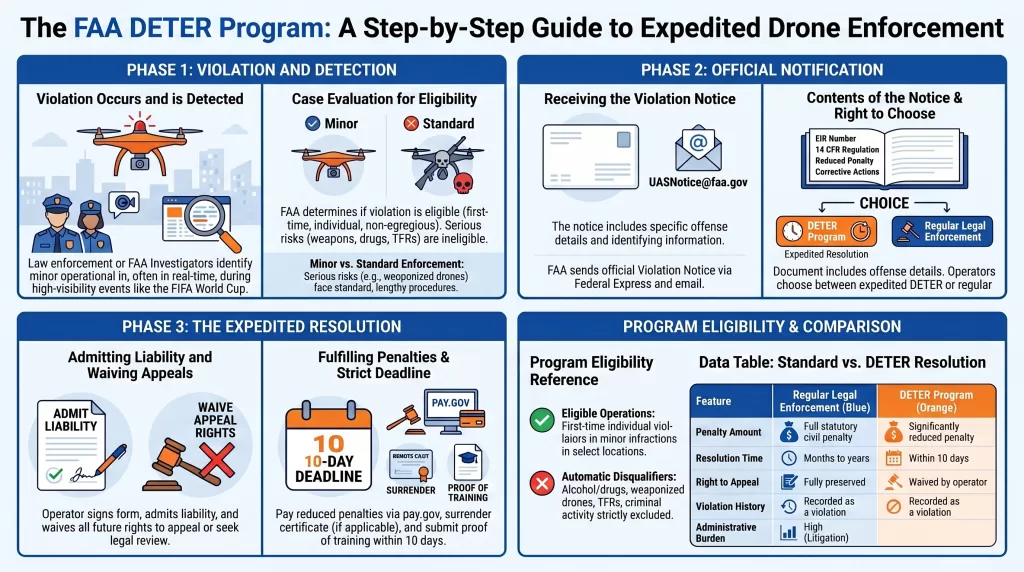
Launched in April 2026, the FAA’s Drone Expedited and Targeted Enforcement Response (DETER) program introduces a faster, more streamlined enforcement pathway.
For certain lower-level violations, the FAA can now bypass lengthy investigations and move directly to resolution. Operators flagged under DETER receive a formal Violation Notice—delivered via email and FedEx—triggering a 10-day decision window.
This is more than a timeline—it’s a 10-day ultimatum that forces immediate, high-stakes decision-making.
Factor
Timeline
Penalties
Admission
Appeals
Record
DETER Track
10 Days
Reduced
Required
Waived
Permanent
Standard Enforcement
Months
Full Statutory
Negotiable
Preserved
Case-dependent
The tradeoff is clear: speed comes at the cost of rights, leverage, and long-term flexibility.
3. The Hidden Cost of “Convenience”
At face value, DETER appears efficient—even beneficial. But for serious operators, it introduces a set of long-term risks that can quietly undermine business growth.
Permanent Record, Permanent Consequences
Participation requires an admission of liability, creating a permanent violation record. For commercial operators, this can directly impact:
- Future Part 107 waivers (BVLOS, Operations Over People)
- Contract eligibility with enterprise and government clients
- FAA inspection outcomes under 107.7
Operational Disruption
If suspension is involved, pilots must surrender their certificate within 10 days—resulting in immediate grounding and potential revenue loss.
Compressed Decision Pressure
The 10-day window limits your ability to:
- Seek legal guidance
- Evaluate long-term business impact
- Build a strategic response
You’re not just responding—you’re reacting under constraint.
Waived Protections
Operators forfeit appeal rights and eligibility for legal fee recovery. The decision is final—no second look.
4. Where DETER Does Not Apply
DETER is not a universal safety net. High-risk violations bypass the program entirely and move straight to full enforcement.
These include:
- Substance-related operations (alcohol or drugs)
- Weaponized drones
- Criminal activity
- Temporary Flight Restriction (TFR) violations
- Egregious or reckless conduct
- Lack of pilot qualification
In high-security environments—such as major global events—the enforcement ecosystem is now real-time and integrated. The gap between incident and enforcement action is rapidly shrinking.
5. The Aerial Strategist’s Playbook
In this new environment, compliance is no longer enough. What’s required is strategic risk management.
Adopt a Zero-Guess Policy
If airspace authorization is unclear, delayed, or questionable—do not fly. A missed flight costs time; a violation costs opportunity.
Document Everything
Flight logs are no longer administrative—they are defensive tools. Detailed records can challenge or validate enforcement claims in a fast-track system.
Treat Compliance as a Competitive Advantage
Operators who demonstrate discipline and consistency position themselves for:
- Advanced operational approvals
- Enterprise partnerships
- Regulatory trust
Think Before Takeoff
- Every enforcement outcome begins on the ground.
- The moment you power up is the moment your risk exposure is locked in.
Takeaway: Protecting What You’ve Built
The DETER program is not designed for strategic operators—it’s designed to process violations quickly.
For professionals, the implications are deeper. A single expedited settlement may resolve a short-term issue, but it can impose a long-term ceiling on business growth, certification flexibility, and contract viability.
The 10-day ultimatum is not just an enforcement mechanism—it’s a signal:
There is no longer room for reactive decision-making in this industry.
The winning strategy remains unchanged—but the stakes are higher:
- Know the rules
- Respect the airspace
- Eliminate uncertainty before launch
Because in today’s enforcement environment, the real objective isn’t just completing the mission—it’s protecting the business behind it.
If you have any questions, let us know! If you’d like to hire us, you can get more information here.
Written by: Tony Marino, MBA – FAA Certified Part 107 Commercial Drone Pilot and Chief Business Strategist at Aerial Northwest
Disclaimer: The information provided in this blog post is for general informational purposes only and should not be construed as legal advice.
Drone Pilot MBA Series
Your Next Drone Flight Might Be Your Last: New FAA’s “DETER” Rules

Resources
FAA Resources: FAA DroneZone
FAA Resources: FAA DETER Program
Article: What Does it Mean to Decode the Drone Industry?
Article: Pitch Perfect: Guide for Drone Pilots to Get Jobs
Drone Business Strategy Magazine (Study Report):
PESTEL Analysis: A Critical Tool for Commercial Drone Pilots
Drone Business Strategy Magazine (Study Report):
Drone Pilot SWOT Analysis: The Key to Commercial Success
Starting Your Own Drone Service Business
Pick up your copy today on Amazon and wherever fine books are sold.

DRONE BUSINESS STRATEGY MAGAZINE
A free digital publication made exclusively for all small business drone pilots to them help start-up, become profitable while sustaining a competitive advantage within the drone service industry sector they opt to serve.
“If you love to fly, we’d love to have you come aboard!”
We share your information with no one. Our Privacy Policy.







1 Comment
Leave your reply.