


The Industry Doesn’t Need More Gurus
As a business strategist and real estate media specialist, I’ve witnessed firsthand why so few succeed while so many fail. The real estate industry has never suffered from a lack of opinions. Open social media, attend a conference, or scroll through industry news, and you’ll quickly encounter a parade of self-appointed experts, market prophets, marketing wizards, AI gurus, and business coaches claiming to possess the secret formula for success. Some offer valuable insights. Many offer noise.
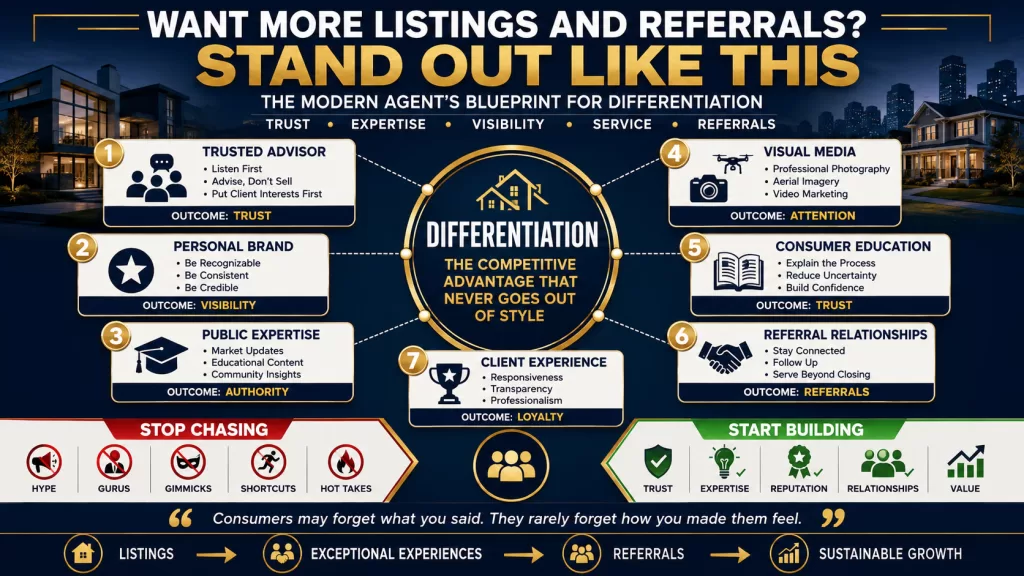
The challenge facing today’s real estate professional isn’t finding information, it’s determining which information is actually useful. While industry headlines continue to focus on interest rates, commission changes, artificial intelligence, inventory shortages, and market uncertainty, the agents quietly outperforming their peers are concentrating on something far more important: differentiation.
Not hype. Not gimmicks. Not shortcuts. Differentiation. Because in a marketplace where consumers have more access to information than ever before, the professionals who consistently succeed are those who create value that cannot easily be replaced.
“The future belongs to professionals who become indispensable—not interchangeable.”
The Consumer Has Changed
Today’s consumers can search listings online, estimate home values, watch real estate videos, read market reports, compare neighborhoods, and research mortgage options on their own. Information is no longer scarce. What remains scarce, and what consumers still desperately need, is judgment, experience, and trust.
What many agents haven’t fully considered is that the informed consumer is not a threat, they’re a gift. A client who has done their research arrives at the relationship with context, engagement, and genuine questions. They’re not passive. They’re invested. And an invested client, guided by a skilled agent, makes better decisions, moves with more confidence, and becomes a far more enthusiastic referral source than a client who felt confused throughout the process and simply deferred to whoever was in front of them.
The agents who struggle with today’s informed consumer are usually the ones whose value was always built on controlling access to information. That model is gone. The agents who thrive are those who welcome a well-researched client, meet them at their level, and add the layer of local expertise, negotiation skill, and professional judgment that no algorithm, portal, or AI tool has yet been able to replicate. The consumer hasn’t made the agent obsolete. They’ve simply raised the bar for what a good agent looks like.
The role of an agent has evolved beyond transactions. The role today is guidance.
Becoming a Trusted Advisor
The phrase “trusted advisor” gets used frequently, but few agents fully understand its significance. A trusted advisor doesn’t begin every conversation with a sales pitch. They begin with questions. They listen, seek understanding, and prioritize the client’s goals before recommending solutions. Consider the difference between two agents meeting a prospective seller. The first arrives with a pre-prepared listing presentation, pricing recommendations, and a closing strategy. The second arrives with a single question: “Before I tell you anything about what I do, can you tell me what matters most to you about this move?” One agent is performing. The other is advising. Consumers can feel the difference immediately — and they remember it long after the transaction closes.
Sometimes the right advice is to buy. Sometimes it’s to wait. Sometimes it’s to sell. And occasionally, the best advice is to do nothing at all. The agents who are willing to say “I don’t think this is the right time for you,” and mean it, are the ones who earn clients for life. That kind of honesty is rare enough that when consumers encounter it, they tell everyone they know. Consumers recognize authenticity, and when clients believe your recommendations are driven by their best interests rather than your next commission check, trust begins to form. Trust creates relationships. Relationships create referrals. Referrals create businesses.
Building a Personal Brand That Matters
Consumers rarely remember brokerage slogans. They remember people. They remember experiences. And they remember professionals who helped them navigate uncertainty. A strong personal brand isn’t about becoming an influencer, it’s about becoming recognizable, relatable, and reliable.
The strongest personal brands are built through consistency: consistent communication, consistent expertise, consistent professionalism, and consistent visibility. Consumers don’t need to see perfection. They need to see credibility.
What most agents never consider is that consistency itself is the differentiator. A market update published every month for three years quietly signals something no single piece of marketing can buy: staying power. Consumers notice the agent who keeps showing up, in their inbox, in their feed, in their community, long after the initial impression has faded. Trust isn’t built in a moment. It accumulates. And the agents who understand that treat every touchpoint, however small, as a deposit into a reputation account that compounds over time.
“People don’t hire logos. They hire people they trust.”
Expertise Must Be Demonstrated
Many professionals assume expertise speaks for itself. It doesn’t. Consumers can’t evaluate what they can’t see. That’s why successful agents are increasingly demonstrating expertise publicly: through market updates, educational videos, community insights, neighborhood reports, articles, public speaking, and local involvement.
The objective isn’t self-promotion. It’s evidence. The goal is helping consumers understand why your guidance deserves consideration. In an era of information abundance, the agents who consistently show their work build reputations that speak before they ever enter a room.
What holds most agents back isn’t a lack of knowledge, it’s a fear of being visible. They wait until they feel ready. They postpone the video until the lighting is better, the market update until the data is cleaner, the article until they have more time. Meanwhile, a less experienced agent down the street is already publishing, already being found, already building familiarity with the exact consumers they’re hoping to reach. Expertise that stays private helps no one. The willingness to share what you know, consistently, accessibly, without waiting for perfect — is itself a form of professional courage that consumers recognize and reward.
Visual Media Is No Longer Optional
The first showing often happens online. The first impression frequently happens before a conversation ever takes place. Consumers evaluate properties visually, and increasingly, they evaluate agents the same way. Professional visual media communicates competence, attention to detail, and commitment to quality in ways that words alone cannot. This matters more than most agents realize. Studies consistently show that listings with professional photography sell faster and closer to asking price than those without. Aerial imagery gives buyers spatial context that ground-level photography simply cannot provide, the relationship of the property to its surroundings, the lot boundaries, the neighborhood character, the proximity to amenities. These are not luxury add-ons. They are the information buyers are already looking for before they ever request a showing. Beyond individual listings, video has become the most effective medium for agent brand-building. A well-produced neighborhood tour, a market update presented on camera, or a behind-the-scenes look at what the buying process actually involves, these create familiarity and trust at scale. Consumers who have watched an agent explain a complex topic on video arrive at the first meeting already feeling like they know them. That’s an extraordinary advantage that no business card or yard sign can replicate.
Whether it’s professional photography, aerial imagery, property video, educational content, or community storytelling, visual media has become a business development tool, not simply a marketing expense. The objective isn’t showing off technology. The objective is communicating value. And in today’s market, agents who invest in that communication consistently outperform those who don’t. “The listing that looks like it was photographed on a smartphone tells buyers something about how the seller’s agent approaches their work. Presentation is a signal.”
Education Creates Confidence
Consumers delay decisions when they feel uncertain. They move forward when they feel informed. This is why educational content consistently outperforms traditional promotional messaging. People genuinely appreciate professionals who help them understand market conditions, pricing strategy, financing realities, inspection concerns, negotiation processes, and local trends.
Education builds confidence. Confidence builds trust. Trust builds business. There’s a productive irony here: the agents who focus least on “selling” often earn the most opportunities to serve. When you become the professional who helps people understand what’s happening in the market, not just the one asking for their listing, the calls start coming to you.
The Referral Economy Still Wins
Technology continues to evolve. Marketing platforms continue to change. Algorithms continue to shift. Yet one truth remains remarkably consistent: referrals remain the highest-quality source of business. The reason is simple: trust transfers. When a client recommends an agent, they are placing their own reputation behind that recommendation. No advertisement can fully replicate that dynamic.
Referral-driven businesses are built through exceptional service, reliable communication, post-closing follow-up, community engagement, and long-term relationship building. Referrals are not generated by transactions. They are generated by experiences, and the agents who understand that distinction run very different businesses than those who don’t.
Referrals are not generated by transactions.
They are generated by experiences.
Client Experience Is the Ultimate Differentiator
Most consumers won’t remember every statistic discussed during a transaction. They won’t remember every form or every market report. But they will remember how they were treated. They will remember responsiveness, transparency, professionalism, empathy, and reliability. What separates adequate from exceptional is usually not dramatic. It’s the agent who calls before the client has to ask. It’s the follow-up email after a difficult inspection that says “Here’s what this means and here’s what we do next,” not a list of problems, but a path forward. It’s checking in three months after closing just to see how the move went. None of these things require extra hours. They require intention. The agents with the strongest referral networks are rarely the ones with the flashiest marketing. They’re the ones whose past clients feel genuinely cared for, not processed. When someone asks a friend for an agent recommendation, they’re not asking for the agent who ran the most ads. They’re asking for the agent their friend trusted during one of the most stressful experiences of their life. That’s the standard worth building toward. Every interaction contributes to the client experience, and every client experience contributes to your reputation. The best marketing often occurs after the transaction closes. That’s when clients decide whether your name becomes part of their story, the professional they enthusiastically recommend to family, friends, and colleagues.
The best marketing often occurs after the transaction closes. That’s when clients decide whether your name becomes part of their story, the professional they enthusiastically recommend to family, friends, and colleagues. Everything before that moment is simply preparation for that decision.
“Consumers may forget what you said. They rarely forget how you made them feel.”
Facts Over Personalities
One of the greatest challenges facing today’s real estate industry is the increasing tendency to reward personalities over principles. Attention is often mistaken for expertise. Confidence is often mistaken for competence. Opinion is frequently presented as fact.
Real estate professionals should approach every industry trend, prediction, and hot take with thoughtful skepticism. Ask questions. Review data. Seek multiple perspectives. Verify claims. Avoid making important business decisions based solely on social media popularity. The professionals who consistently succeed tend to focus less on rhetoric and more on results, studying facts, serving clients, adapting to changing conditions, and remaining committed to professional excellence.
What makes this particularly important is that your clients are watching how you think, not just what you know. An agent who blindly repeats a market prediction they heard on a podcast is one bad forecast away from a damaged relationship. An agent who says “here’s what the data actually shows in our local market, and here’s how I’d interpret it for your situation” is demonstrating something far more valuable than confidence, they’re demonstrating judgment. In a profession built on trust, the willingness to say “I don’t know, but let me find out” will always outperform the performance of certainty. Consumers are more sophisticated than the industry sometimes gives them credit for. They notice the difference.
Takeaway
The industry will continue to evolve. Technology will change. Markets will fluctuate. Business models will adapt. Consumer expectations will grow. Yet one principle remains remarkably stable: people want to work with professionals they trust.
The agents who thrive in the years ahead will not necessarily be the loudest voices in the room. They will be the professionals who become trusted advisors, build recognizable personal brands, demonstrate expertise publicly, use high-quality visual media, create educational content, develop referral-driven businesses, and deliver exceptional client experiences.
In an increasingly competitive marketplace, differentiation is not achieved through hype. It is earned through value. And value remains one of the few competitive advantages that never goes out of style.
If you have any questions, let us know! If you’d like to hire us, you can get more information here.
Written by: Tony Marino, MBA – FAA Certified Part 107 Commercial Drone Pilot and Chief Business Strategist at Aerial Northwest
Disclaimer: The information provided in this blog post is for general informational purposes only and should not be construed as legal advice.
Resources
FAA Resources: FAA DroneZone
Article: FCC’s DJI, Autel ban ignores how drones actually work
Article: What Does it Mean to Decode the Drone Industry?
Article: Pitch Perfect: Guide for Drone Pilots to Get Jobs
Resource: Drone Service Providers Alliance
Drone Business Strategy Magazine (Study Report):
PESTEL Analysis: A Critical Tool for Commercial Drone Pilots
Drone Business Strategy Magazine (Study Report):
Drone Pilot SWOT Analysis: The Key to Commercial Success
Starting Your Own Drone Service Business
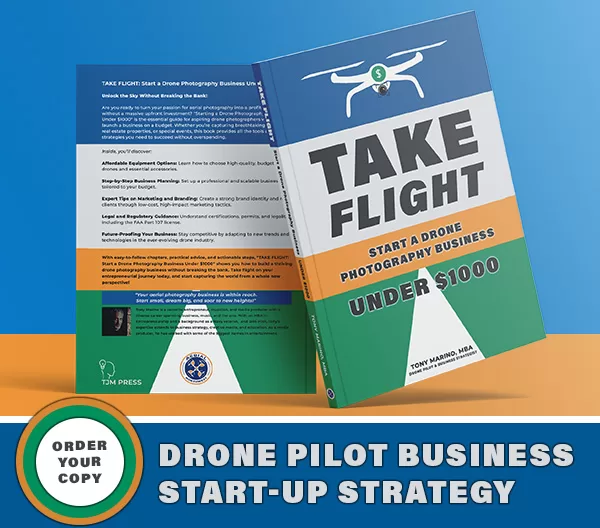
Pick up your copy today on Amazon and wherever fine books are sold.
DRONE BUSINESS STRATEGY MAGAZINE
A free digital publication made exclusively for all small business drone pilots to them help start-up, become profitable while sustaining a competitive advantage within the drone service industry sector they opt to serve.
“If you love to fly, we’d love to have you come aboard!”
We share your information with no one. Our Privacy Policy.







Leave a reply
Your email is always safe with us.