

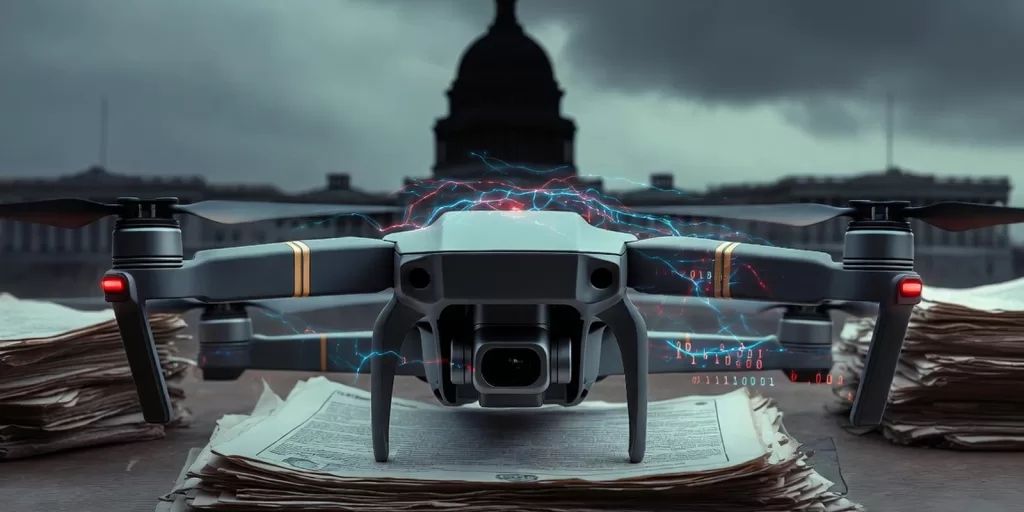
In the world of government regulation, a severe national security threat usually triggers an unambiguous, binary response. If a specific model of laptop battery is found to spontaneously catch fire, it is banned from commercial aircraft immediately. If a batch of lettuce is contaminated with E. coli, it is scrubbed from every grocery store shelf in the country overnight. In these cases, the response matches the stated severity: an absolute and immediate shutdown.
However, we are currently witnessing an unbridgeable gap between Washington rhetoric and commercial reality regarding the American drone industry. While regulators at the Federal Communications Commission (FCC) label Chinese-manufactured drones as an “immense immediate threat” due to data collection risks, tens of thousands of these same devices continue to fly over critical infrastructure every single day.
The Drone Service Providers Alliance (DSPA), representing over 33,000 certified remote pilots, recently submitted a filing to the FCC that pulls back the curtain on this looming crisis. Their argument is clear: the current push for a blanket geographic ban is a blunt instrument that ignores technical reality while threatening to hollow out the domestic commercial drone sector.
1. The Failure of Binary Logic
The current regulatory stance fails the most basic test of logic. If a piece of hardware is inherently a “flying spy balloon” in every context, it should have been grounded months ago. Instead, regulators are debating a phased-out approach. This sends a baffling message: the device is a critical threat to the nation, but we’ll let you keep flying it for a few more years because replacement is inconvenient.
To illustrate this absurdity, consider a city claiming a specific brand of delivery van contains a tracking device sending routes to a foreign adversary. Despite this claim, the city continues to allow the police, fire departments, and local businesses to drive those same vans into secure areas because replacing the fleet is too expensive. This suggests that the “threat” is being managed through political convenience rather than technical necessity. For policymakers, banning a brand name is the path of least resistance—it is easy to draft and pass. In contrast, the hard, expensive work of regulating actual digital behavior requires a level of technical literacy and auditing capacity that Washington has yet to muster.
2. The Geographic Fallacy: Why ‘Made in USA’ Isn’t a Silver Bullet
A central theme of the DSPA filing is that a drone’s manufacturing “address” is no guarantee of its security. In the cybersecurity world, this is a dangerous distraction. Evaluating safety based purely on where a company is headquartered creates a false sense of security while leaving the “digital back door” wide open on American-made hardware.
The DSPA identifies four specific vulnerabilities often found in “NDAA compliant” or US-made hardware:
- Insecure firmware updates
- Weak encryption protocols
- Poor vulnerability management
- Uncontrolled cloud dependencies
The last point—uncontrolled cloud dependencies—is the “how” behind the risk. If a US-made drone is programmed to connect to a third-party server to update software or verify a license before takeoff, that connection is a dependency. If that server is compromised, it doesn’t matter if the plastic and metal were assembled in Texas; the data remains vulnerable to interception or malicious code injection.
“A geographic ban is a blunt instrument. Evaluating security based purely on the manufacturer’s address ignores how data actually flows.”
3. The 97% Problem and the Economic Vacuum
The commercial drone industry is not a niche hobbyist group; it is a critical sector built almost entirely on foreign platforms. Chinese manufacturers like DJI dominate the market not just through pricing, but through a combination of sensor reliability, battery availability, and seamless third-party software integration.
The last point—uncontrolled cloud dependencies—is the “how” behind the risk. If a US-made drone is programmed to connect to a third-party server to update software or verify a license before takeoff, that connection is a dependency. If that server is compromised, it doesn’t matter if the plastic and metal were assembled in Texas; the data remains vulnerable to interception or malicious code injection.
“A geographic ban is a blunt instrument. Evaluating security based purely on the manufacturer’s address ignores how data actually flows.”
Metric
Commercial operators using DJI drones
Public safety users (Police, Fire, Search & Rescue) relying on DJI
Pilots who learned to fly on DJI systems
Percentage
96.7%
97.0%
80.0%
The cost of a total ban would be astronomical. Fleet replacement for state agencies alone is estimated to cost between $10 million and $50 million—and that is just the tip of the iceberg, as it excludes the thousands of local police and fire departments. Beyond the hardware, there is the “operational downtime” and the massive cost of retraining pilots on entirely new ecosystems with incompatible software, batteries, and charging stations.
4. The ‘Shadow Ban’ and the Market Vacuum
Even without a formal law, we are seeing the “Shadow Ban” effect: regulatory uncertainty causing the surrounding ecosystem to reject hardware that is still technically legal. This manifests through changing federal funding rules, tightening state procurement standards, and shifts in the insurance market.
For example, a local roofer using a $5,000 drone for storm damage inspections may find their commercial liability insurance suddenly excludes Chinese-made hardware due to “data breach” concerns. Overnight, a functional tool becomes a paperweight because the operator cannot risk the liability of flying it.
The data shows a industry in distress:
- 60% of operators are already reporting supply shortages and price hikes.
- 24% of respondents state they will likely shut down their businesses entirely if a broad ban is implemented.
The irony is that Washington’s desire to boost the domestic industry may actually kill off the customer base. Small businesses—the real estate photographers and cell tower inspectors—may go under before American manufacturers can scale up production to fill the void.
5. The Surgical Solution: Behavioral Threat Modeling
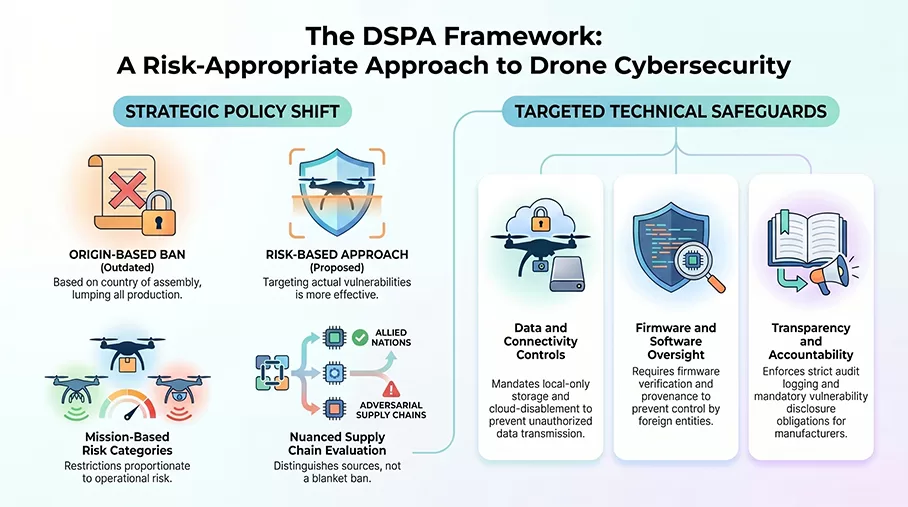
Rather than a blunt geographic ban, the DSPA proposes a “risk-appropriate framework” based on what the cybersecurity world calls threat modeling. This approach shifts the focus from where a drone was made to how it behaves and where it is flown.
Consider the smartphone analogy:
- Low Risk: A smartphone with no SIM card or Wi-Fi, used only to take photos of a garden.
- High Risk: A smartphone synced to a corporate network, transmitting live data from inside a major bank’s server room.
The DSPA’s blueprint suggests three specific technical controls to neutralize espionage threats regardless of manufacturing origin:
- Local-only data storage: Ensuring data never leaves the device.
- Cloud disablement switches: A verified software switch that ensures the drone cannot physically talk to the internet during operation.
- Audit logging: An unalterable record of every data connection made by the drone. This allows a pilot to “mathematically prove” to a client that no data left the device during a mission.
Takeaway: The Bigger Picture: Firmware Provenance and the Future of Tech
The drone industry is the “tip of the spear” for a much larger technological shift. As hardware becomes increasingly software-defined, the physical origin of a tool matters less than Firmware Provenance—the verifiable history of who wrote, tested, and updated the code running the machine.
The precedents set here will dictate how we regulate all connected hardware, from GPS-guided tractors on family farms to smart HVAC systems in commercial high-rises. If we cannot easily rebuild global supply chains at home, we must learn to secure the technology we have.
The question for the future is no longer just about where a device is made, but whether we can trust the code inside it. In a globalized world, is “learning how to securely turn off the Wi-Fi” the only viable path forward for national security?
If you have any questions, let us know! If you’d like to hire us, you can get more information here.
Written by: Tony Marino, MBA – FAA Certified Part 107 Commercial Drone Pilot and Chief Business Strategist at Aerial Northwest
Disclaimer: The information provided in this blog post is for general informational purposes only and should not be construed as legal advice.
Resources
FAA Resources: FAA DroneZone
Article: FCC’s DJI, Autel ban ignores how drones actually work
Article: What Does it Mean to Decode the Drone Industry?
Article: Pitch Perfect: Guide for Drone Pilots to Get Jobs
Resource: Drone Service Providers Alliance
Drone Business Strategy Magazine (Study Report):
PESTEL Analysis: A Critical Tool for Commercial Drone Pilots
Drone Business Strategy Magazine (Study Report):
Drone Pilot SWOT Analysis: The Key to Commercial Success
Starting Your Own Drone Service Business
Pick up your copy today on Amazon and wherever fine books are sold.

DRONE BUSINESS STRATEGY MAGAZINE
A free digital publication made exclusively for all small business drone pilots to them help start-up, become profitable while sustaining a competitive advantage within the drone service industry sector they opt to serve.
“If you love to fly, we’d love to have you come aboard!”
We share your information with no one. Our Privacy Policy.






Leave a Reply
Your email is always safe with us.