

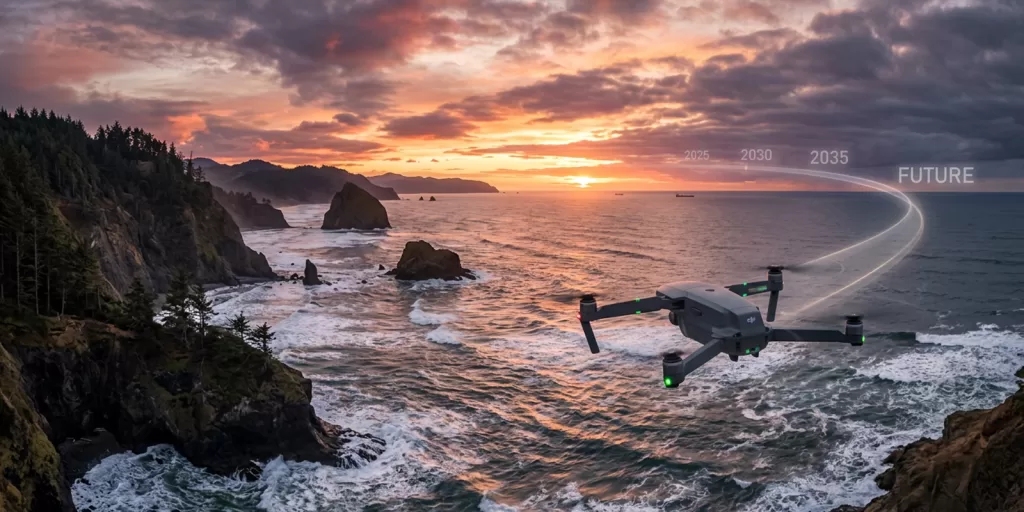
The drone industry is entering a new phase, and the entrepreneurs who understand where the market is heading will be the ones best positioned to stay profitable, competitive, and relevant. What once worked—buying a drone, getting certified, and offering aerial imagery—is no longer enough to sustain a durable advantage. As the market matures, deeper structural forces are reshaping how drone service providers compete, specialize, and deliver value, making long-term success less about equipment and more about strategy.
By 2027, the drone economy will be defined by automation, data-driven services, specialization, regulatory expansion, and integrated technology platforms that are changing how aerial work is performed across multiple industries. Operators who recognize these shifts early can plan ahead, adapt their business model, and position themselves where opportunity is growing instead of where competition is increasing. Understanding these forces does not guarantee success, but ignoring them almost guarantees falling behind.
A Simpler Time in the Drone Industry
Only a few years ago, starting a drone business was relatively simple. You bought a drone, obtained your Part 107 certification, and began offering aerial imagery. For many early drone entrepreneurs, that formula worked well and remained profitable for quite some time.
Typical early services included:
- Real estate photography
- Construction progress images
- Marketing and promotional visuals
- Basic aerial video production
Clients were excited by the perspective drones could provide, and the barrier to entry was still high enough that competition remained limited.
Today’s Drone Service Provider Landscape
Today, the landscape looks very different. There are now thousands of drone pilots offering similar services. Many use the same aircraft, follow similar workflows, and compete for the same types of projects. The advantage of simply owning a drone has faded, and the market has become far more competitive. At the same time, something much larger is happening beneath the surface. Drones are no longer just tools for capturing images. They are becoming part of the operational infrastructure of multiple industries.
Organizations now rely on aerial technology for:
- Construction site monitoring
- Energy and utility inspections
- Agricultural analysis
- Environmental documentation
- Infrastructure management
As the industry matures, the way drone businesses create value is changing—and several powerful forces are driving that change.
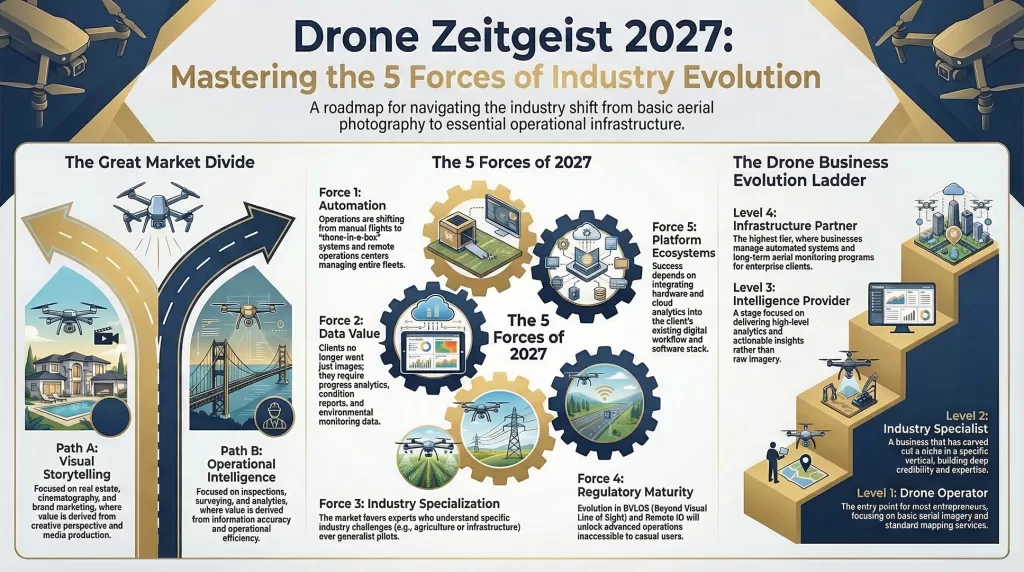
The Drone Economy Is Splitting Into Two Paths
One of the most important shifts happening in the drone industry today is the emergence of two distinct market paths.
Path One: Visual Storytelling
Some drone businesses focus primarily on creative and marketing applications, such as:
- Real estate imagery
- Cinematic video production
- Tourism and destination visuals
- Brand marketing content
- Media and advertising work
In this path, the value comes from perspective, creativity, and storytelling. Clients are not buying flight time. They are buying visuals that help them communicate.
Path Two: Operational Intelligence
Other drone businesses focus on services that support real-world operations, including:
- Inspections
- Mapping and surveying
- Infrastructure monitoring
- Environmental analysis
- Construction analytics
Here, the value comes from information, accuracy, and efficiency. Clients are not buying images. They are buying insight. Both paths will continue to exist, but both are being shaped by the same underlying forces that are redefining the industry.
The Five Industry Forces Shaping the Drone Market
When viewed from a strategic perspective, five forces are driving the evolution of the drone economy.
Force 1 — Automation
Drone operations are gradually moving away from one-off flights toward repeatable systems.
Examples include:
- Drone-in-a-box deployments
- Automated inspection routes
- Scheduled monitoring flights
- Remote operations centers
Instead of flying one drone at a time, operators may eventually manage entire fleets. This changes the business model from: Individual flights → Operational systems. Companies that can build repeatable workflows will have a clear advantage.
Force 2 — Data Value
In the early days of the industry, the product was the image. Today, the product is increasingly the information created from that image.
Clients now expect:
- Progress analytics
- Condition reports
- Measurement data
- Monitoring records
- Documentation for decision-making
The drone flight becomes the data collection step. The real value comes from what the data reveals. Drone businesses that can turn imagery into useful insight will be far more competitive than those that only deliver files.
Force 3 — Industry Specialization
As the market matures, general drone services become harder to differentiate.
Successful operators are focusing on specific industries, such as:
- Real estate marketing
- Construction monitoring
- Agriculture analysis
- Infrastructure inspection
- Tourism media production
Clients prefer working with professionals who understand their field. Specialization builds expertise, credibility, trust, and repeat business. And in a competitive market, trust is often more valuable than technology.
Force 4 — Regulatory Maturity
Regulation continues to expand what is possible in commercial drone operations.
Key developments include:
- BVLOS operations
- Remote ID implementation
- Advanced airspace integration
- Expanded operational approvals
As the regulatory environment matures, professional operators will gain access to opportunities that casual pilots cannot pursue. Understanding compliance, safety, and planning will become a competitive advantage.
Force 5 — Platform Ecosystems
The drone industry is increasingly built around integrated technology platforms.
Modern workflows often combine:
- Aircraft hardware
- Flight software
- Cloud processing
- Data analytics
- Automation tools
Drone services are becoming part of larger operational systems inside client organizations. Businesses that can integrate into those systems will be more valuable than those offering isolated flights.
The Drone Business Evolution Ladder
When these five forces combine, drone businesses naturally begin to move up the value chain. This progression can be understood as a four-level ladder.
Level 1 — Drone Operator
This is where most entrepreneurs begin.
Typical services include:
- Aerial imagery
- Video capture
- Mapping flights
- Basic inspections
The value comes from flying the drone.
Level 2 — Industry Specialist
At this level, the business focuses on one specific niche.
Examples may include:
- Real estate media
- Construction monitoring
- Agricultural surveys
- Infrastructure inspection
The value comes from industry knowledge, not just flight skill.
Level 3 — Intelligence Provider
Here, the business delivers insight rather than imagery.
Services may include:
- Data analysis
- Progress reports
- Measurement results
- Monitoring documentation
The value comes from information that helps clients make decisions.
Level 4 — Infrastructure Partner
At the highest level, drone companies become part of ongoing operations.
Examples include:
- Automated inspection programs
- Recurring monitoring systems
- Long-term service contracts
- Integrated aerial workflows
The value comes from reliability, systems, and long-term capability. The higher a business moves up this ladder, the more valuable its service becomes.
Takeaway: What This Means for Drone Entrepreneurs
The drone industry is no longer in its early phase. The advantage once came from owning a drone, but the next era will reward those who understand the industries they serve, deliver meaningful insight, and build systems that create long-term value. The most successful drone businesses will increasingly operate as media specialists, data providers, infrastructure partners, and aerial systems operators rather than simple flight service providers.
The drone itself is no longer the differentiator—strategy is. Entrepreneurs who recognize this shift early can position themselves where the market is going instead of competing where it has already been. The future of the drone industry will not be defined by who can fly, but by who can solve real problems using aerial technology. And that future is already taking shape.
If you have any questions, let us know! If you’d like to hire us, you can get more information here.
Written by: Tony Marino, MBA – FAA Certified Part 107 Commercial Drone Pilot and Chief Business Strategist at Aerial Northwest
Disclaimer: The information provided in this blog post is for general informational purposes only and should not be construed as legal advice.
Resources
FAA Resources: FAA DroneZone
Article: What Does it Mean to Decode the Drone Industry?
Article: Pitch Perfect: Guide for Drone Pilots to Get Jobs
Drone Business Strategy Magazine (Study Report):
PESTEL Analysis: A Critical Tool for Commercial Drone Pilots
Drone Business Strategy Magazine (Study Report):
Drone Pilot SWOT Analysis: The Key to Commercial Success
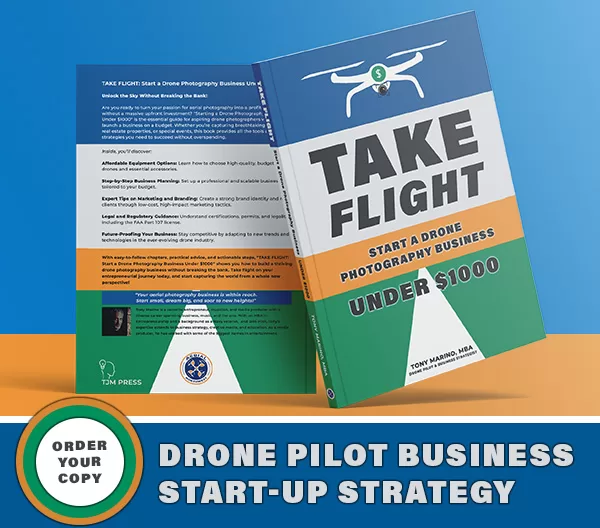
Starting Your Own Drone Service Business
Pick up your copy today on Amazon and wherever fine books are sold.

DRONE BUSINESS STRATEGY MAGAZINE
A free digital publication made exclusively for all small business drone pilots to them help start-up, become profitable while sustaining a competitive advantage within the drone service industry sector they opt to serve.
“If you love to fly, we’d love to have you come aboard!”
We share your information with no one. Our Privacy Policy.





Leave a Reply
Your email is always safe with us.